Removing Institutional Barriers to Sustainability
A compilation of information and resources for legalizing sustainability. Items in italic on menu at right have not been used so much (or not at all...yet). This list is California/ US-oriented, but will be useful anywhere in the industrialized world.
On this page
"All truth pass through three stages:
First, it is ridiculed. Second, it is violently opposed. Third, it is accepted as being self- evident."
—Arthur Schopenhauer
"Our current codes are as effective at preventing the best practices
as they are for precluding the worst ones."
—David Eisenberg
"The more ecologically you live, the more illegal it is."
—Art Ludwig
 Why Legalize Sustainability?
Human activity is putting such strain on the natural functions of Earth that the ability of the planet’s ecosystems to sustain future generations can no longer be taken for granted.
Protecting and improving our future well-being requires wiser and less destructive use of natural assets. This in turn involves major changes in the way we make and implement decisions.
Nearly two thirds of the services provided by nature to humankind are found to be in decline worldwide. In effect, the benefits reaped from our engineering of the planet have been achieved by running down natural capital assets.
In many cases, it is literally a matter of living on borrowed time. By using up supplies of fresh groundwater faster than they can be recharged, for example, we are depleting assets at the expense of our children.
Unless we acknowledge the debt and prevent it from growing, we place in jeopardy the dreams of citizens everywhere...as well as increasing the risk of sudden changes to the planet’s life-support systems from which even the wealthiest may not be shielded.
Better protection of natural assets will require coordinated efforts across all sections of governments,
businesses, and international institutions. The productivity of ecosystems depends on policy choices on investment, trade, subsidy, taxation, and regulation, among others.
—The United Nations Millennium Ecosystem Assessment (reflecting the work of hundreds of diverse organizations and more than 1,360 experts worldwide)
Sustainable development meets the needs of the present without compromising the ability of future generations to meet their own needs
—World Commission on Environment and Development
Sustainability: Living on natural income, not natural capital
"The most dangerous thing we could possibly do is continue business as usual"
—David Eisenberg
Even as all of humanity’s life-support systems are threatened, the more ecologically you live, the more illegal it is.
Where I live in Santa Barbara for example, 20,000-sq.-ft. mansions are approved routinely, but living in a yurt is illegal. You can build an entirely passive-solar and wood-heated house, but code also requires a fossil-fueled central-heating system. If a sewer passes the house, you must hook up to it, and pay for the privilege, even if the sewer is on camera leaking directly into a creek, and on-site wastewater treatment and reuse is demonstrably safer and more ecological. Older structures are often charming in their human scale. You may wish to build a human-scale, easily heated structure like this, but code requires exterior doors to be 6'8" tall, which, after adding required framing above, makes a cozy-scale house difficult to achieve.
Our plumbing codes evolved to protect us from 19th-century risks. Certainly, we still need plumbing that won’t spread cholera. But while plumbing codes reduced the risk of disease from minute to infinitesimal, they don't address emerging, 21st century hazards. If we do not change our built environment to address global warming, aquifer depletion, and groundwater contamination, we will eventually be as bad off as in the cholera era, then worse.
We need to encourage research and gain more experience with super resource-efficient systems now, for an orderly transition to a post-peak world.
It would be very adaptive for humans to increase the rate of research and development on not just slightly less damaging systems, but also systems that have radically lower adverse impacts.
Under the current regime, the door is basically all the way open, or all the way shut to a given building practice. For virtually all systems that have radically lower impacts, say half or less, the door is shut.
The idea promoted here is to open the door a crack for these "growing edge" systems, to give them a chance to be developed and proven.
Then, they can be added to the main code as options, or, if warranted, mandates.
The emerging hazards not addressed by codes are much larger than the historical hazards that are. Thus, non-compliant historical buildings and unpermitted natural buildings are often safer than new, code-compliant buildings
The existing Building Safety system is working extremely well for 19th century hazards—Structural collapse, structure fires, waterborne disease.
The existing Building Safety system is not addressing 21st century hazards—Cancer from cumulative toxin exposure, heart disease from reduced movement, climate disruption.
Together, the new hazards which codes do not yet adequately address are far bigger than all the old hazards together, and the new hazards are growing rapidly—The US cancer death rate has tripled since 1900, despite greatly improved treatment. In 1900, one in 1800 people contracted cancer. Today, one in 3 people is expected to develop cancer in their lifetime.
The US prides itself on having the safest buildings in the world. This is true if you only look at old building hazards. If you look at all building hazards, our built environment is as dangerous as that of scary third world buildings often cited as the reason we need strict codes—Pakistan has a history of deadly earthquakes and shoddy construction. October 8th 2005, the 14th most deadly quake in recorded history killed 86,000 Pakistanis. This was one of four deadly quakes in the past fifty years. Yet...The risk of an American contracting fatal cancer from US buildings is the same or greater as the risk of a Pakistani being killed in an earthquake, about 18 deaths per million per year.
Summary Quantitative analysis of risks attributable to the built environment (PDF) Editable (xls) full version (spreadsheet showing dramatic shifts in 19th and 21st century hazards, with all citations, sources, and calculations)
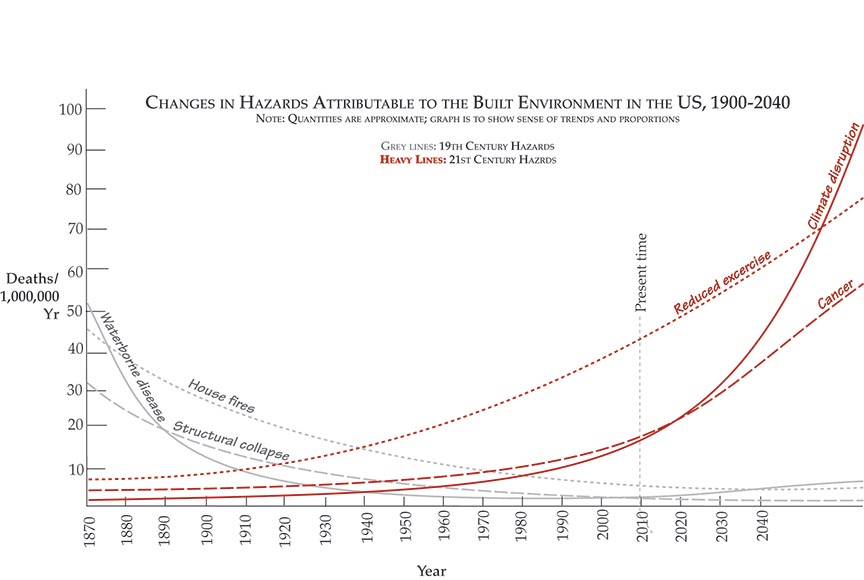
Each of the top three current risks is bigger by itself than the top three historical risks combined
Slide show of quantitative hazard highlights (.mov, 4 min, 13 mb)
Possible Legal Umbrella Strategies
What we really need is an officially endorsed legal framework for innovators, academics, builders, manufacturers, and regulators to collaborate on rapid, high quality innovation. In the meanwhile, here is an inventory of strategies to get over, around, under or through institutional barriers to sustainability.
In more or less ascending order of set up difficulty... the idea is that a few percent of new systems could be built very differently under these alternate compliance scenarios, to speed the evolution towards all systems being more efficient and higher performance.
If you have a resource to suggest, or other comment, please Email us .
Under the radar
In terms of the speed, flexibility, and low compliance overhead, just going forth without permits is hard to beat. Most code and zoning enforcement is by complaint, only. One chief building official estimated that 40% of all projects in his wealthy California county were done without permits, so this approach is by no means limited to deep green building research projects.
In California, with it's absence of legal provision for sustainability research, "under the radar" is the de facto official system for field testing and advancing the state of the art in sustainable building technology. Many technologies have become well-established under the radar, then made transition into official policy—a transition made slow and ineffective by the absence of legal prototypes to study.
There are serious drawbacks to the under the radar approach:
- Your project is one phone call from disaster, from a disgruntled neighbor or ex tenant.
- Unpermitted status complicates publishing, having workshops, and site visits from researchers, industry representatives, and building officials, slowing progress and frustrating collaboration (though there is precedent for building officials visiting unpermitted projects outside of their district)
Exempt or Waived
There are various categories of work that are exempt from permit. For a typical example—
SECTION 105.2 EXEMPTED WORK
BUILDING: A building permit shall not be required for the following:
1. One-story detached accessory buildings used as tool and storage sheds, patio covers, playhouses, playground or athletic equipment and similar uses provided the floor area does not exceed 120 square feet.
...
12. [For SFM] State-owned buildings under the jurisdiction of the state fire marshal.
Note that "building permit not required" does not technically mean exempt from code compliance, though in practice this distinction rarely comes into play. A rarely used, but powerful tool is code exemption:
...
105.2.4 WAIVER OF PERMIT. The Building Official may, by administrative order, waive permit requirements for work which is not inimical to the public health, safety or welfare, or which because of its temporary nature or special purpose, does not fall within the purview or intention of this Code.
Delayed or deferred enforcement
Most counties have code compliance issues on their dockets that have been there for years or decades. Consciously or unconsciously, most building officials sense that red-tagging, fining, or bulldozing state of the art sustainable buildings that are providing safer, more affordable housing is counter to their mission to minimize hazards attributable to the built environment.
This can lead to half-hearted enforcement, or a tacit or explicit agreement to look the other way for "under the radar" projects that have come to the attention of authorities.
Compliance agreements
County planning and development departments typically have discretion to enter into project-specific compliance agreements for anything that doesn't fit the standard compliance path. The local discretion is wide for zoning issues, less so for building codes. These may inflict some pain, but allow a portion of a project to continue to exist.
Ask for forgiveness, not permission
In some cases, creating the model first and getting a bunch of attention, good and bad, has resulted in regulations being changed to accommodate the new practice. City Repair, in Portland, Oregon is a master of this approach:
According to a 2007 StreetFilms[3] post, when City Repair first attempted some of these events many years ago, the Portland Office of Transportation (PDOT) did not sanction it. Undaunted, communities went ahead and did them anyway! Thankfully, today times have changed: PDOT has an official liaison to City Repair who helps coordinate permitting and street closures and also oversees some of the design standards. (From Streetswiki)
These ideas sprouted from conversations over tea in a community space piled with cushions, built from recycled materials by neighbors for about $65 in 1996. The city ordered the teahouse demolished, as it did not meet codes. And the city tried to fine neighbors for creating community amenities on the corners of the intersection. One city official even said, “That's public space. Nobody can use it.” Then the neighbors complained to the city commissioners. They invited them for tea. Suddenly, city officials realized that the kind of citizen initiatives happening at Share-It Square were the sort they had been trying to inspire with expensive programs for decades. And it was all happening at no cost to the city. The city passed an ordinance to encourage “intersection repair” in all 96 neighborhoods of Portland. Today, with the help of an informal organization called City Repair, citizens are invited to design paintings for the centers of intersections and creative public spaces on the four corners. Portland's ordinance requires that 80 percent of neighbors within two blocks sign statements approving the plan...
Jan Semenza, whose studies of public health have suggested that “urban planning processes may contribute to the epidemics of obesity, diabetes, and depression that are sweeping the United States,” has assigned his students to study neighborhood reactions to the Sunnyside Piazza over time, and to compare crime and other statistics with those at comparable unimproved intersections in demographically parallel neighborhoods. After more than 700 interviews, they concluded that 65 percent of Sunnyside Piazza-area residents rated their neighborhood an excellent place to live, compared with 35 percent at another similar but unimproved intersection. Also, 86 percent of Sunnyside neighbors reported excellent or very good general health, compared with 70 in the adjacent neighborhood. And 57 percent versus 40 percent said they felt “hardly ever depressed,” even in Portland's rainy weather. Calls for police services have decreased since the intersection repair. (From Yes Magazine)
Political support
This isn't so much a specific mechanism as a strategy that can help with any other option on this list. If you have overwhelming political support from the public, higher in the chain of authority, elected officials, or another, respectable source, this can shift the balance of power in favor of deferred enforcement or change in regulations.
For example, city councils and county boards of supervisors are often more progressive, and definitely have more authority than the building enforcement officials that work for them. If they fall in love with your project, they may ask the building department to call off the dogs while they figure out a regulatory mechanism to allow your project, or permanently.
Suggestions:
- Get policy statements into meeting public records, general plans, etc. that support deep green building, a sustainability research field testing site, and so on. This is routinely done aspirationally, even when there is currently no regulatory mechanism to implement the policy
- Government is not monolithic. There may be departments down the hall from the one that is red-tagging your building that see the value in your work and may be willing to support it in one way or another. The fact is that natural buildings address many common policy objectives and mandates better than more easily permitted construction. These can include runoff reduction, landfill reduction, air quality, water quality, fire safety, traffic reduction, affordable housing, support for local economy and tradespeople, etc.
- Form official or unofficial relationships with local institutions of higher learning, to collect data on the performance and safety of your projects; this adds data and credibility
- Form a coalition of allies in the business or non-profit world; chamber of commerce, unions, environmental organizations
There are huge areas of overlapping interest between sustainability researchers and conventional building science people. We are natural collaborators; an adversarial relationship is an artifact of rules that lump people advancing the state of the art in safe building together with unscrupulous contractors trying to foist shoddy, unsafe buildings on unsuspecting buyers. This conflation can be overcome through communication.
An inspiring example that actually codified the exercise of discretion in favor of deep green projects is Seattle's city council bill accommodating its rules for Living Building Challenge buildings, via its Living Building Pilot Program:
The purpose of the Pilot Program is to allow additional flexibility in the application of development standards in the Land Use Code (Title 23) through the design review process in order to accommodate innovative technologies or design approaches that might otherwise be discouraged or prohibited. The Pilot Program will accept up to 12 projects over a 3-year period. All projects accepted into the program will undergo full design review through the existing design review process pursuant to Chapter 23.41. The scope and criteria for design review departures will be modified to allow, to the extent that Code departures may be necessary, the Board to recommend an expanded range of departures from Code requirements including: limited departures from permitted accessory uses, height, and floor area ratio (FAR). In recommending departures, the board must find that the project meets design guidelines and the goals of the Living Building Challenge. Projects participating in the Pilot Program benefit from Priority Green FACILITATED. Applicants in Priority Green FACILITATED will benefit from: * Priority plan review that moves your project ahead of others. * An integrated, coordinated review that can identify and resolve issues for complex projects before it’s too late.
Existing, non-conforming
Structures that predate more stringent codes are often "grandfathered" in. This is great for old technologies, but provides limited legal protection for growing edge technologies (except to the extent they overlap old ones).
As best as we can make out, the legal force behind existing, non-conforming comes not from building codes, but from a general legal principle that things that were legal when done cannot be made illegal after the fact.
This protection of existing structures and systems is not universal. For example, unsafe existing structures can be red-tagged, and California requires that cesspools be reported and abandoned.
Permissive jurisdictions; counties w/o building codes, Indian reservations, university land, other countries, etc.
Many places even in the US still do not have building codes. Federal government land, ironically, can be a great place to take shelter from local codes.
Areas for research:
What is the legal/ scientific basis for the legality of defecating in shallow holes in the ground in national forests, even for gatherings of 25,000 people? If it is based on science, logically it would translate to private land if properly done under appropriate circumstances.
Could a new land use designation be made for sustainability research, that would be the equivalent of a new "Indian tribe" of sustainability researchers, with reservation/ research sites?
"Alternative Materials and Methods" sections in existing codes
Most codes have a section that allows Alternative Materials and Methods. These give authority to the local Enforcing Agency, to approve any alternate method/ means/ device on case by case basis, that is at least equivalent as what is required in the regular code, and has the same protections for life, health safety.
This authority is entirely local. How useful these are in practice is entirely up to the local administrative authority. An open-minded administrative authority can use "Alternative Materials and Methods" to allow construction that meets a draft, non-adopted standard, or standards from other jurisdictions, or any other standard they wish.
Research needed: Case histories of beneficial applications of Alternative Materials and Methods for innovative building.
New code language needed: guidelines/ encouragement for making the best use of AMM for innovative, resource-efficient technologies, such as
- Explicitly enumerating the option of evaluating a building as a whole system, instead of going over the design with a checklist.
- Explicitly encouraging the consideration of off-site impacts to non-occupants in assessing equivalency of protections for life, health, and safety.
Experimental Permits
Good experimental permit language could facilitate the passage of worthy new designs through Schopenhauer's three stages of truth, above.
Raw research notes on experimental permits (doc). Sometimes there is a requirement or expectation that the results will be reviewed or published.
Research needed: Text and adoption history for experimental permit language anywhere in the world they've been used.
New code language needed: Model experimental permit language.
CA Title 25 Limited Density Rural Dwelling Regulation, AKA Alternative Owner Builder (AOB), AKA Code K
Various jurisdictions in the US have Alternative Owner Builder (AOB) codes, including Mendocino, Humboldt, Nevada and Butte counties in California, Cochise County, AZ, and San Juan County, WA. These allows owners to take responsibility for the safe design and construction of their homes. Fees are minimal. There is minimal inspection, for public safety issues, only. Sometimes there is an upper size limit.
Liability stays with the owner, not the regulators. A note to this effect may be recorded on the deed, so all future owners are informed that they are responsible for the structure's safety. Raw research notes on AOB codes (doc).
Besides the option of using the existing, locally adopted AOBs for sustainability research, a jurisdiction that might not want to allow its traditional use for mountain shacks, might be able to re-purpose the broad AOB authority for the purpose of sustainability research, with requirements for, for example, ongoing access, relationship with an institution of higher learning, publishing of data, and improvement of public domain natural building technologies. The state law could also be modified to encourage this use.
(3) It has been determined that the adoption of regulations for limited density rural dwellings will not constitute a danger to the health and safety of the citizens of Mendocino County as long as standards for electrical, mechanical and sanitation facilities are maintained.
(4) Mendocino County has a severe housing shortage. Low cost housing is especially hard to find in the County and the adoption of regulations for limited density rural dwellings will encourage the further construction of such dwellings.
(5) State law mandates the County of Mendocino to adopt a General Plan which makes adequate provisions for housing its citizens. The adoption of regulations for limited density rural dwellings is an attempt by the County to achieve an acceptable housing inventory for its General Plan. State law further requires the County of Mendocino to provide shelter for those residents qualifying for general relief. The general welfare of the County requires the adoption of regulations for limited density rural dwellings so that all County residents may be housed.
(6) The Uniform Building Codes are complex and may be beyond the understanding of many owner-builders and home owners. Yet they allow the Building Department a great degree of flexibility in applying them giving rise to charges of lack of uniform application and that in fact virtually all structures in the County are in some degree in violation of the law. The geographical and topographical conditions of the County creates such isolation that it is difficult to conduct the necessary inspections to verify or refute this charge. Because the Uniform Building Codes are of such complexity that they are difficult to enforce under the geographical, topographical and climatic conditions of the County, common sense dictates that these codes be replaced by the regulations for limited density rural dwellings which provide a performance standard of evaluation.
Humboldt County Alternative Owner Builder Code
CHAPTER 1.5
MODIFIED LIMITED DENSITY
OWNER-BUILT RURAL DWELLING REGULATIONS
(FOR ALTERNATIVE OWNER BUILDERS)
331. 5-1. GENERAL PROVISIONS.
On July 10, 1984, the Humboldt County Board of Supervisors, duly made findings that there are special local conditions within specified areas of Humboldt County where modifications and changes of the standard regulations for limited density owner-built rural dwellings are reasonably necessary because of local climatic, geographical or topographical conditions. The rural housing construction standards adopted by this chapter are modifications to the standard building regulations otherwise applicable in Humboldt County and are adopted pursuant to Section 17958.5 of the Health and Safety Code. (Ord. 1644, §2, 7/10/84)
331. 5-2. PURPOSE AND INTENT.
The modifications contained in this chapter are intended to permit, under specified circumstances, the use of the ingenuity and preferences of individual builders of dwellings intended for occupancy by the builder in designated areas of Humboldt County, while at the same time maintaining minimum requirements for the protection of life, limb, health, property, safety and welfare of the general public and the occupants of dwellings constructed pursuant to this chapter. It is further intended to allow the use of substitute materials and procedures and alternatives to the specifications prescribed by the uniform technical codes to the extent that a reasonable degree of health and safety is provided by these modifications.
In applying these modifications, the Chief Building Official shall have the authority to exercise reasonable judgment in determining compliance with all requirements of this chapter. (Ord. 1644, §2, 7/10/84)
Nevada County Compliance Permit Program (pdf) Program to allow existing, owner-built, rural dwellings to get building permits. Includes allowances for composting toilets and graywater disposal.
Nevada County Layman's Guide Through the Maze to Utilizing the Nevada County Deferred Compliance and Title 25 [Alternative Owner/Builder] Programs (pdf) Guide made by a non-governmental organization to help homeowners get permits under the Alternative Owner Built (AOB) Housing Program for new buildings, and the Deferred Compliance (DC) program for existing buildings.
Sonoma County Chapter 7a - Regulations For Limited Density Owner-Built Rural Dwellings
Authority For AOBs from CA State Statute Same thing on CA HCD web site
Research needed: Legend has it that these were adopted to avoid losing a court case based on counties' infringement of citizens constitutional right to shelter. True? Not true? in any case I'm sure the story is fascinating. Please send any info you've got on it.
Low Impact Performance Code
This is another possibility for an alternate system for low impact, high performance buildings: You show that the building will outperform the average by a given margin (say, 50%), and will not pose a public safety hazard, and that's it: you're green lighted.
The rationale for such a program is strong: the external costs and impacts from a building system that uses 1/5th of the resources are so much lower that it is to society's advantage to bend over backwards to encourage such structures to be built.
The benefits include:
- An immediate reduction in impact
- Free (to society) R&D on the lowest impact systems
Such a system could be tiered, with greater incentives for higher performance.
Research needed: Text and adoption history for anywhere in the world they've been used.
New code language needed: Model low impact performance code; how to measure, how to evaluate, etc.
Integrated Design Alternative Compliance Standard
This is another flavor of Low Impact Performance Code, with emphasis on the fact that the project is evaluated as a whole system, with explicit acknowledgment of synergy effects from subsystems fitting well together, the most fertile area for improving building performance.
The rationale for explicitly directing regulators attention to the whole picture is strong: the effects of a building are felt in reality as not as the sum of isolated parts, but as a cumulative, interconnected whole.
Research needed: Text and adoption history for anywhere in the world they've been used.
New code language needed: Model Integrated Design Standard; how to measure, how to evaluate, etc.
Camping ordinance
Camping regulations are a whole different regulatory system than building codes. There is arguably much less of a jump to low impact, sustainable permanent settlement from camping than there is from current building codes. Ditto for affordable housing. Many jurisdictions likely have camping ordinances on the books that could be adapted (as is or with modification) to enable safe, ultra low-impact housing. Dignity Village in Portland, where many formerly homeless live, is one example. Here is another example of a camping ordinance, enacted to help house returning soldiers after WWII:
Santa Barbara County Camping Ordinance
Sec. 24-5.3. Sleeping or camping in certain areas prohibited—Generally—Exceptions. It shall be unlawful for any person to sleep or camp between the hours of one half hour after sunset of one day and 6:00 A.M. of the next day, whether inside or outside of a vehicle in or on any: (a) Public road, or (b) Public property, except that up to five vehicles may be parked in a used for overnight sleeping in the county parking lot adjacent to the county administration building and if following conditions are met: (1) The county has entered into a management agreement under which the contracting party agrees to assume administration and management of a program to oversee such use of the county administration parking lot. (2) The management agreement referenced above satisfies all county concerns regarding liability, due process, evictions, fair housing notice and employee safety. (3) All vehicle occupants enter into a written agreement with the contracting party in a form approved by the county and comply with all terms and conditions of that agreement. (c) Private property, including but not limited to beaches, vacant lots, parking areas and commercial properties, unless the person sleeping or camping in or on such private property; (1) Is the owner thereof or the lessee of such property or the house guest of such owner or lessee, or (2) Has the permission of the owner of such property, his agent or the person in lawful possession of such property and sanitary facilities approved by the health officer of the county are available on such property to the person sleeping or camping in or on such property. (Ord. No. 4330, § 1; Ord. No. 4514, § 1; Ord. No. 4531, § 1; Ord. No. 4547, § 1; Ord. No. 4574, § 1) Sec. 24-5.2. Definitions. Unless the particular provisions or the context otherwise requires, the definitions contained in this section shall govern the construction, meaning and application of words and phrases used in this section. (a) "Camp" means to pitch or occupy camp facilities; to use camp paraphernalia. (b) "Camp facilities" include, but are not limited to, tents, huts or temporary shelters. (c) "Camp paraphernalia" includes, but is not limited to, tarpaulins, cots, beds, sleeping bags, hammocks or non-county designated cooking facilities and similar equipment. (d) "Public property" means all property owned or controlled by the county. (e) "Road" means the same as defined in section 28-1 of this Code. (f) "Sleep" means the natural, regularly recurring rest for the body, during which there is little or no conscious thought. (g) "Temporary shelter" means any shelter not authorized by, or approved by, the County of Santa Barbara building department for permanent occupancy. (h) "Vehicle" means the same as defined in section 23-16 of this Code. (Ord. No. 2009, § 2; Ord. No. 4330, § 1)
Research needed: Text of camping codes from diverse jurisdictions, and examples of their use to allow semi-permanent, low impact camping on people's own land.
New code language needed: Model camping ordinance.
Conservation Living Preserve or Easement
A new type of preserve could be designated, along the lines of agricultural preserves or conservation easements. The concept is that the owner takes their land out of the maximum development revenue potential pool, and agrees to binding reduction in negative impacts to the earth's life support system. In return, they get lower taxes (the land is now less valuable, because, for instance, you can't build a 10,000ft2 house on it), and can/must use alternative compliance paths for any building on the property, such as the low impact performance code, or experimental permits.
Compliance could be ensured by a third party that holds the easement, as is the case with habitat conservation easements.
Research needed: Investigate history and properties of other kinds of easements and preserves.
New code language needed: Model conservation living preserve language.
Experimental zones, zoning or sites
Specific sites can be designated for higher ecological or performance standards, and/or more leeway to try new approaches.
For example, The Battery Park City in lower Manhattan (where the World Trade Center was) has very high green building and development standards. To enable these to be attained, they created an authority to negotiate and champion integrated designs on behalf of all the design teams and developers with all the various regulating entities. This was very effective to remove barriers streamline approvals.
This could be a natural extension of an environmentally sensitive habitat designation, conservation zoning, agricultural or nature preserve, etc.
The University of California and state college campuses would be well-suited to this work, perhaps making housing for students in the Education for Sustainable Living program.
In New Mexico, Michael Reynolds of Earthship fame got HB 269 SUSTAINABLE DEVELOPMENT TESTING SITE ACT through the New Mexico State Legislature, a process documented with the amazing and entertaining movie Garbage Warrior.
From the Hawaii Revised Statutes - "46-15 Experimental and demonstration housing projects"
§46-15 Experimental and demonstration housing projects.
(a) The mayor of each county, after holding a public hearing on the matter and receiving the approval of the respective council, shall be empowered to designate areas of land for experimental and demonstration housing projects, the purposes of which are to research and develop ideas that would reduce the cost of housing in the State. Except as hereinafter provided, the experimental and demonstration housing projects shall be exempt from all statutes, ordinances, charter provisions, and rules or regulations of any governmental agency or public utility relating to planning, zoning, construction standards for subdivisions, development and improvement of land, and the construction and sale of homes thereon; provided that the experimental and demonstration housing projects shall not affect the safety standards or tariffs approved by the public utility commissions for such public utility.
The mayor of each county with the approval of the respective council may designate a county agency or official who shall have the power to review all plans and specifications for the subdivisions, development and improvement of the land involved, and the construction and sale of homes thereon. The county agency or official shall have the power to approve or disapprove or to make modifications to all or any portion of the plans and specifications.
The county agency or official shall submit preliminary plans and specifications to the legislative body of the respective county for its approval or disapproval. The final plans and specifications for the project shall be deemed approved by the legislative body if the final plans and specifications do not substantially deviate from the approved preliminary plans and specifications.
The final plans and specifications shall constitute the standards for the particular project. No action shall be prosecuted or maintained against any county, its officials or employees, on account of actions taken in reviewing, approving, or disapproving such plans and specifications.
Any experimental or demonstration housing project for the purposes herein above mentioned may be sponsored by any state or county agency or any person as defined in section 1-19.
The county agency or official shall apply to the state land use commission for an appropriate land use district classification change, except where a proposed project is located on land within an urban district established by the state land use commission. Notwithstanding any law, rule, or regulation to the contrary, the state land use commission may approve the application at any time after a public hearing held in the county where the land is located upon notice of the time and place of the hearing being published in the same manner as the notice required for a public hearing by the planning commission of the appropriate county.
(b) The experimental and demonstration homes may be sold to the public under terms and conditions approved by the county agency or official who has been designated to review the plans and specifications.
(c) The county agency or official may adopt and promulgate rules and regulations which are necessary or desirable to carry out the purposes of this section. [L 1970, c 108, §1; am L 1975, c 142, §1; am L 1977, c 207, §1; am L 1984, c 66, §1]
Indigenous Hawaiian Architecture Structures from the Maui County Building Plan Review Section
From the Maui Building Code:
104.2.8 Alternate materials, alternate design and methods of construction. The provisions of this code are not intended to prevent the use of any material, alternate design or method of construction not specifically prescribed by this code, including elements based on or inspired by principles of indigenous architecture, such as those associated with structures comprised of either rock walls or wood frames for the bottom portion of structures and thatch of different native grasses and leaves for the roof, provided any alternate has been approved and its use authorized by the building official.
The building official may approve any such alternate, provided the Board of Code Appeals has previously granted an exception pursuant to section 16.25.105 of this code in the same or substantially similar circumstances and the building official finds that the proposed design is satisfactory and complies with the provisions of this code and that the material, method or work offered is, for the purpose intended, at least the equivalent of that prescribed in this code in suitability, strength, effectiveness, fire resistance, durability, safety, and sanitation.
The following material are examples of the types of material that may be considered by the building official, if used for the construction or renovation of a structure that is based on or inspired by principles of indigenous architecture: Wood for house timbers (walls): hamau, kauila, lama, nioi, and 'ohi'a; and
House thatch and lining material (roof): lala 'ama'u (fern fronds), lauhulu and lau mai'a (banana leaves); pa'a'a mai'a (banana trunk layers); pili, maoli, pu'upu'u pueo, kawelu, kiolohia, 'aka 'akai, uki, and lele (grasses and leaves, sedges, bulrushes); lauhala, ko'o, i'o ko'o, mu'o hala, pu'awa, pukani, pilila'ele, la'ele, pala lauhala, pa'ilau'ula, and ki (pandanus leaf); and lau ko, lau'o, lako, and la'o (sugarcane leaves).
The building official shall require that sufficient evidence or proof be submitted to substantiate any claims that may be made regarding the use of the alternate. The details of any action granting approval of an alternate shall be recorded and entered in the files of the code enforcement agency.
The Uniform building code is amended by adding thereto a new chapter, to be designated and to read as follows:
Chapter 36: INDIGENOUS HAWAIIAN ARCHITECTURE
3601 Policy. This code shall be administered with due consideration given to the County policy that indigenous Hawaiian architecture furthers the County's compelling interests in cultural, environmental, and historic preservation; energy efficiency; economic development; aesthetic beauty; and public safety. For purposes of this section, indigenous Hawaiian architecture includes any of the predominant architectural practices, customs, styles, and techniques historically employed by the native residents of the Hawaiian Islands, including structures comprised of either rock walls or wood frames for the bottom portion of structures and thatch of different native grasses and leaves for the roof.
3602 Rules. The building official shall adopt rules to further the County policy on indigenous Hawaiian architecture. The rules shall specifically identify predominant architectural styles and techniques historically employed by the native residents of the Hawaiian Islands and their descendants. The rules shall express general approval of such styles and techniques, to the extent that they do not conflict with the building code's overall purposes.
3603 Housing code exclusion. All indigenous Hawaiian architecture structures constructed in accordance with this chapter are not required to comply with requirements in chapter 16.08, Maui County Code, pertaining to the housing code.
3604 Indemnification and responsibility. The property owner shall defend, indemnify and hold harmless the County, its officers and agents, from all claims, demands, suits, actions or proceedings of every name, character and description which may be brought against the County for or on account of any injuries or damages to any person or property as a consequence of any work done under a permit issued for an indigenous Hawaiian architecture structure. (Ord. 3090 § 1, 2002: Ord. 3026 § 1, 2001: Ord. 2887 § 3, 2000)
Download the code section for "Rules Pertaining to Indigenous Hawaiian Architecture Structures" here (pdf)
Research needed: Text and adoption history for anywhere else in the world they've been used. Europe, perhaps?
New code language needed: Model language for experimental zones, zoning and designation of individual sites.
Movie Set
I heard an unconfirmed rumor that (in California) you can build essentially anything you want as a movie set. Perhaps we need a movie, filmed over decades, on the options to build sustainably, documented with measurements and data collection? To add drama it could be set against the forces of profiteering building materials suppliers and trade organizations.
California Historical Building Code
Last updated: 12/29/2011.
According to at least one chief building official, for the California Historical Building Code to apply,
(1) the structure must be designated historical,
(2) Someone must request that this code be applied.
Note that a historical building does not have to be old. It just has to be deemed of importance to the history, architecture or culture of an area by an appropriate local or state governmental jurisdiction. My understanding is that the idea is to keep current building codes from reducing the values enumerated above for future generations. This raises the intriguing prospect that relatively recent sites with sustainability features that rise to a sufficient level of historical interest for future generations could be permitted by an enlightened local jurisdiction. Moreover, if the "character-defining features" were the sustainability features, those would merit special protection in the application of the CHBC.
The historical building code is also of keen interest in the different approach it takes to regulation:
- it acknowledges that other considerations can be balanced against strict interpretation of the code and provides reasonable, common sense guidelines for doing so
- it acknowledges and encourages the ability of regulators to judge the safety of all sorts of non-standard systems on a case by case basis
- the process by which it was developed and administered could provide a template for similar alternative codes, for example for sustainability research sites (see ...the background, below)
Excerpts from 2010 California Historical Building Code California Code of Regulations, Title 24, Part 8 2010 version with highlights from Oasis:
The California Historical Building Code (CHBC) is unique among state regulations. The authoring of the original CHBC required state agencies promulgating regulations for building construction to work in harmony with representatives of other design and construction disciplines. The result was a totally new approach to building codes for historical structures, which maintains currently acceptable life–safety standards. These regulations are also unique in that they are performance oriented rather than prescriptive...
...in order to use the CHBC, the structure under consideration must be qualified by being designated as an historical building or structure...
...a qualified historical building or structure is any structure or collection of structures, and their associated sites deemed of importance to the history, architecture or culture of an area by an appropriate local or state governmental jurisdiction. This shall include structures on existing or future national, state or local historical registers or official inventories, such as the National Register of Historic Places, State Historical Landmarks, State Points of Historical Interest, and city or county registers or inventories of historical or architecturally significant sites, places, historic districts or landmarks.”
...The background of the California Historical Building Code can be traced to December 1973, when the State Department of Parks and Recreation published the California History Plan, Volume I, in which Recommendation No. 11 was proposed by the then California Landmarks Advisory Committee (later to become The State Historical Resources Commission). This proposal expressed a need for a new building code to meet the intent of protecting the public health and safety and also retain “enough flexibility to allow restoration of a Historic feature while still retaining its Historic integrity.” No. 11 of this History Plan supported this need by stating that “. . . restoration . . . is frequently made difficult by unnecessarily rigid interpretation of building . . . codes.” In March of 1974, the Landmarks Committee by resolution recommended that the Director of the State Department of Parks and Recreation and the State Architect initiate a study to develop this needed code. These two officials accepted this concept and jointly called a statewide meeting in Sacramento on May 14th of that year. Attending were representatives from both the public and private sectors, such as members of the building industry, design professions, local and state building officials, and others interested in this problem. Out of this open conference, a steering committee was formed to explore in depth the ways and means of implementing the new historical building code concept...
...The CHBC is intended to provide solutions for the preservation of qualified historical buildings or properties, to promote sustainability, to provide access for persons with disabilities, to provide a cost-effective approach to preservation, and to provide for the reasonable safety of the occupants or users...[emphasis added]
......8-103.3 Liability. Prevailing law regarding immunity of building officials is unaffected by the use and enforcement of the CHBC...
This is a slightly more reasonable version of Alternate Materials and Methods than that which is found in the main code body:
... The CHBC does not preclude the use of any proposed alternative or method of design or construction not specifically prescribed or otherwise allowed by these regulations. Any alternative may be submitted for evaluation to the appropriate enforcing agency for review and acceptance. The enforcing agency may request that sufficient evidence or proof be submitted to substantiate any claims that may be made regarding such solutions. Any alternative offered in lieu of that prescribed or allowed in the CHBC shall be reasonably equivalent in quality, strength, effectiveness, durability and safety to that of the CHBC.
This sort of discretion occurs throughout the CHBC. It provides a good precedent for regulators to evaluate systems on a case by case basis, rather than purely by formula:
...Existing systems which do not, in the opinion of the enforcing agency, constitute a safety hazard may remain in use.
...The enforcing agency may approve any alternative to these regulations which achieves reasonably equivalent life safety...
There are a number of non-standard solutions generally or specifically permitted:
8-903.2.1 Where toilet facilities are provided, alternative sewage disposal methods may be acceptable if approved by the local health department.
8-5. 8-303.5 Room dimensions. Rooms used for sleeping purposes may contain a minimum of 50 square feet (4.6 m2) floor area, provided there is maintained an average ceiling height of 7 feet (2134 mm). Other habitable rooms need only be of adequate size to be functional for the purpose intended.
...Residential occupancies need not be provided with electrical lighting...
8-502.1 General. The enforcing agency shall grant reasonable exceptions to the specific provisions of applicable egress regulations where such exceptions will not adversely affect life safety.
8-502.2. Existing door openings and corridor widths of less than dimensions required by regular code shall be permitted where there is sufficient width and height for the occupants to pass through the opening or traverse the exit.
8-502.3 Stairs. Existing stairs having risers and treads or width at variance with the regular code are allowed if determined by the enforcing agency to not constitute a distinct hazard. Handrails with nonconforming grip size or extensions are allowed if determined by the enforcing agency to not constitute a distinct hazard.
...Broad judgment may be exercised regarding the strength and performance of materials not recognized by regular code requirements. (See Chapter 8-8, Archaic Materials and Methods of Construction.)
8-902.2 ...Heating facilities. All dwelling-type occupancies covered under this chapter shall be provided with heating facilities. Wood-burning or pellet stoves or fireplaces may be acceptable as heating facilities.
8-903.2.4 Hand washing facilities shall be provided for each dwelling unit and each hotel guest room. A basin and pitcher may be acceptable as adequate hand washing facilities.
8-903.2.5 Hot or cold running water is not required for each plumbing fixture, provided a sufficient amount of water is supplied to permit the fixture’s normal operation.
The code is less flexible with legitimate safety issues, for example with electrical wiring and gas lines.
The CHBC seems to be a fairly comprehensive alternative compliance path:
8-1002.2 Where the application of regular code may impact the associated features of qualified historical properties beyond their footprints, by work performed secondarily, those impacts shall also be covered by the CHBC. 8-1002.3 This chapter shall be applied for all issues regarding code compliance or other standard or regulation as they affect the purpose of this chapter.
Research needed: Examples of use for this purpose? Negative consequences?
Materials needed: Code compliance package.
Religious Land Rights Act
RELIGIOUS LAND USE AND INSTITUTIONALIZED PERSONS ACT OF 2000 (pdf)
This appears to offer options for more flexible use of land.
Ag Worker Housing
Codes can allow simplified construction for agricultural worker housing.
Code Compliance Packages
A code compliance package comprises all the information you need on both sides of the counter to design, evaluate, approve, inspect, and monitor this or that alternative technology.
These can be generated by anyone. The US Green Building Council code committee is beginning work on some of these. DCAT has a general checklist for alternative construction approval. An inspired homeowner could generate them, as can local jurisdictions or code councils.
They consist of a template, which could include checklists, handouts, drawings, forms, references, justification with respect to specific code sections, case studies, precedents, references, criteria for approval, inspection guidance, monitoring or follow up if needed.
They can provide a standard formula for approval in a given jurisdiction. Codes give almost God-like powers to local administrative authorities. Without changing the codes themselves, a local jurisdiction can come up with a formula for negotiating the code in a way that they will accept. I am made such a package for greywater system approval for the city of Santa Barbara. It is a handout they give you from the building department counter with a few design options, complete with technical drawings. You just check off which options apply to your site and hand it back to them.
Research needed: Examples of code compliance packages.
Materials needed: More code compliance packages.
Disaster Preparedness/ Homeland Security
There is a great deal of overlap between averting/ mitigating disaster and sustainable building. Civil defense agencies apparently have little-known, broad authority to intervene in all sorts of systems. There are various funding sources and legal authorizations for homeland security-related actions. Treepeople in Los Angeles has explored this connection in some depth. The culture of civil defense and the culture of sustainability are different in this country, but there is more overlap in other countries. In Denmark, for example, land use regulations support small farms distributed throughout the landscape in part as a national security/ food security measure.
Research needed: Further exploration of the nexus between sustainability and civil defense.
Specific technical stand or legal challenge
Many codes specifically state that they are not meant to exclude everything that isn't specifically enumerated in the code.
When a jurisdiction challenges a professional judgment by an engineer or architect that this or that approach is valid, and request a change, they are in essence:
- Taking the position that they have more technical expertise than a licensed design professional in that field
- Assuming liability for the consequences of their preferred approach
If a jurisdiction prevented from building with adobe, and you build with 2x6's instead, and your house burns down, they might be opening themselves to a lawsuit.
Likewise if they required a moisture barrier in a strawbale wall (which is inadvisable, non-standard practice that could prevent drying), and the wall rots, they would be vulnerable to a lawsuit.
Regulators' actions are highly motivated by risk of litigation. At present, the main fear is being sued because of allowing innovation. Successful lawsuits over the consequences of blocking innovation could introduce some balance in this system.
Thanks to David Eisenberg of the Development Center for Appropriate Technology for the three scenarios above.
Research needed: Examples of past challenges or challenges in progress.
Low Carbon Lifestyle Defense
A specific case of the performance code concept above. Could be an ordinance, or a legal defense. The premise is that global climate disruption constitutes such a clear and present danger that:
- Activities that contribute dramatically to climate disruption could lose legal protection (see below)
- Activities that reduce carbon footprints are so advantageous to society that in some cases they deserve legal protection.
The data on climate disruption are becoming so compelling that the judiciary is starting to take note in case law.
Activists painted the name of a politician in huge letters on the smokestack of a new coal-fired generator in England that he'd subsidized. They got off the hook for tens of thousands of pounds of clean up costs using the English version of the necessity defense.
Presented with the current evidence on global warming, the Judge agreed that the clear and present danger was such that this action was legally protected in a way analogous to someone trespassing and damaging property in order to save a trapped child from a house fire.
This has sent some shock waves out. (See Cleared! Jury Decides That Threat of Global Warming Justifies Breaking The Law):
The threat of global warming is so great that campaigners were justified in causing more than £35,000 worth of damage to a coal-fired power station, a jury decided yesterday. In a verdict that will have shocked ministers and energy companies the jury at Maidstone Crown Court cleared six Greenpeace activists of criminal damage.
Jurors accepted defense arguments that the six had a "lawful excuse" to damage property at Kingsnorth power station in Kent to prevent even greater damage caused by climate change. The defense of "lawful excuse" under the Criminal Damage Act 1971 allows damage to be caused to property to prevent even greater damage - such as breaking down the door of a burning house to tackle a fire.
Under these circumstances, it is dangerous to prevent or red-tag homes that are generating a fraction of the carbon emissions of their neighbors, because the innovations and systems thinking that enables this level of performance are not yet in the building code.
Such a system could be tiered, with greater incentives for higher performance.
Research needed: Case law monitoring for climate disruption.
Case law precedent needed: Get poster-child defendant off the hook for code non-compliance via low carbon lifestyle defense.
Good Samaritan Law
Concept is to protect from liability licensed professionals who are assisting homeowners with:
1) Bringing substandard systems closer to compliance
2) Development of state of the art, high performance systems
Research needed: Good Samaritan relevant case law.
Case law precedent needed: Get poster-child defendant off the hook for common sense improvements to an unpermitted system.
General legal challenge
There are various possible grounds for legal challenge to the existing system of barriers to sustainability. These include:
- Second amendment (non-enumerated rights) right to shelter reputedly used successfully to get Code K AOB codes in Northern California
- Negligent, reckless endangerment This is a favorite of mine; turn the whole liability paranoia around. Imagine the rapid paradigm shift that would ensue if a lawsuit were successfully prosecuted against a jurisdiction for mandating actions that destroy the earth's life support systems, while forbidding those that protect them.
- Freedom of religion Not OK to mandate destruction of all you hold sacred
- Equal protection No more constitutional that you have to be rich to build to code than having to be rich to vote
With all of these strategies, it is necessary to carefully consider the possibility of unintended consequences. For example, a broad victory on freedom of religion or equal protection could open the door to yet more exploitation (in the case of someone who's religion included the belief that it would be an insult to God to not use up all His gifts of natural resources (trees, oil, groundwater) before the second coming. (This is a fair characterization of, for example, the belief system of James Watt, interior secretary under Ronald Reagan). I think the first two options are promising avenues for legal action.
Research needed: Examples of past challenges or challenges in progress.
Appeal to lawyers for trade association resolution
"This would be a liability, sorry..." is all to often the refrain heard when proposing this or that solution. It could be helpful to appeal to lawyer's trade associations and ask for a resolution requesting members to refrain from trying suits against green technologies, and instead to direct their energy towards suing for negligence in continuing to approve conventional construction in the face of irrefutable evidence that this course of action is endangering all the earth's life support systems (see general legal challenge, above).
Moreover, there is little legal basis for the concern that a public employee would be held liable. (See Public Employee Immunity.doc).
Activism needed: Contact lawyers associations and see if any are interested.
Inclusion in Standard Codes
The codes are not static. There is a new code each year. Many ideas that were ridiculed/ resisted found their way into regular codes, eventually. Examples abound: plywood, plastic pipe, drywall, straw bale building, gravelless infiltration galleys, greywater systems.
This can happen through local amendments (usually constrained by State law), as adoptable appendices of the model code, or in the body of the model code itself.
As the code process is highly industry influenced, the trend is in general towards more stringency, which equates with more products sold and more dollars per square foot of sale price and assessed value.
This trend may well reverse, as ecological and economic constraints trump profit maximization. This has happened with Straw Bale construction, and seems to be happening with California Greywater law, for example, see: CA gray water policy center.
Research needed: Examples of inclusions past and in progress.
New code language needed: Inclusion of alternatives as options or mandates as they are proven.
Oasis Design can help your organization write code or provide expert witness services—see Consulting.
Code Irrelevance
As David Eisenberg says, "the most dangerous course of action we could possibly take is to continue the status quo."
The logical consequence of continuing on the path we're on is the depletion of natural resources such as oil, trees, fish, and clean water, the failure of the natural systems that support human life on earth, the collapse of civilized institutions and the end of the rule of law. References
It would be cold comfort, but at this point, codes would be moot.
Leverage Points and Suggested Courses of Action
A basic principle of Integrated Design is that solutions be context-specific. I think all the possible legal umbrella strategies above probably have their appropriate contexts for deployment (excepting, hopefully, the last one).
At the moment, this is the approach appears:
- Advocate for an official, legal umbrella for R&D
- Research centers
- Best practices collaborative web database
- Improved policies for permitting rapidly evolving, proven alternatives
Legal Umbrella for R&D
Experimental permits, experimental zones, or AOBs, or one of the other legal umbrella options above is needed that allows research and development in all manner of possibly useful systems to flourish, and successes and failures to be openly shared.
While Santa Barbara County, for example, is in no way ready for thousands of composting toilets, it is overdue for a few dozen composting toilets of different technologies that are monitored and refined for our area. In several years, as issues with ocean and groundwater pollution and depleting water resources come to more of a head, our community would have a well-founded idea of what the alternatives are
To maximize the chance that the legal umbrella would be part of the solution and not part of the problem, I suggest we write the language ourselves, and lobby to have it adopted. After a few places adopted it, it would doubtless be much easier for others to join the trend.
This work can be engaged at almost any regulatory level; city, county, state, federal, model code...
Research Centers
Research centers would be where various systems could be tried in integrated systems of systems, ideally with documented techniques and measured results. One possible format could be as simple as a spreadsheet showing use of resources. It is interesting that for all the hoopla around green building, natural building, etc. a simple, yet inclusive accounting of all the resources used to make and inhabit a building is a few levels of synthesis beyond what is usually seen.
Best Practices Collaborative Web Databases
As systems are proven or disproved for a given context, this information would ideally be made publicly available on the web.
A dual level wiki might be the ideal vehicle; free for all discussion, with vetted, organized and edited content as well. This is a perfect place to include
- Design approaches including technical drawings, etc. examples: Laundry to landscape ,Earth, & orchard toilets
- Code compliance packages
- Consensus model code language example: Model greywater rules (pdf)
There are several things like this on the web already, including:
- Development Center for Appropriate Technology, DCAT resources
- Oregon Recode
- Natural Building Network
- Sustainable Sources
- Environmental Building News
Improved policies for permitting rapidly evolving, proven alternatives
It seems we need a new model for codes that allows 1) for rapid evolution, 2) evaluation of integrated designs from a wide angle as well as high resolution view. Detailed, proscriptive codes are not suited for this. Performance codes along with reference to current best practices (that are not part of the code and can thus evolve rapidly and independently) might be the best model.
Include public interest representatives among lawmakers
For example, make a requirement that the California Building Standards Commission include these "public interest" representatives (i.e. NOT industry)--
- Climate change expert
- Ecologist
- Biologist
- Environmental human health specialist
- Representative for future generations, etc.
As it stands, the current California Building Standards Law (the law that gives the BSC authority and parameters for its operation) mandates that members be: an architect, licensed contractor, engineers, fire and safety officials, members of the general public.
Thanks to David Eisenberg of the Development Center for Appropriate Technology for help with this page.
If you have a resource to suggest, or other comment, please Email us .
Other countries' approaches
United Kingdom
This information received Jan 2012 from Iliona Khalili:
UK Planning Policy - Tackling Climate Change Through Planning (pdf)
If you have information about other countries' approach to sustainability policy, please Email us .
More Reading
- Live Better, Waste Less
- Eco Design Principles-download

- Builder's GW Guide-book
- Green 4,000 ft2 home?
- Greywater policy center
- CA gray water policy center
- Residential Deep Green Building Checklist [draft] (pdf)
- Residential Deep Green Building Checklist [draft] (doc)
Outside Links
- Development Center for Appropriate Technology, DCAT resources
- Oregon Recode
- US Green Building Council
- California Building Codes online for free from Public Resource
“When I wrote Ecotopia, I imagined people could figure out the sensible ways to run a sustainable society, and then they would start doing it,” he says. “Now I’m more cynical, and I realize that change is much more generational. New ideas don’t triumph because they’re right: They triumph because the people who championed the old ideas die.”
—Ernest Callenbach