
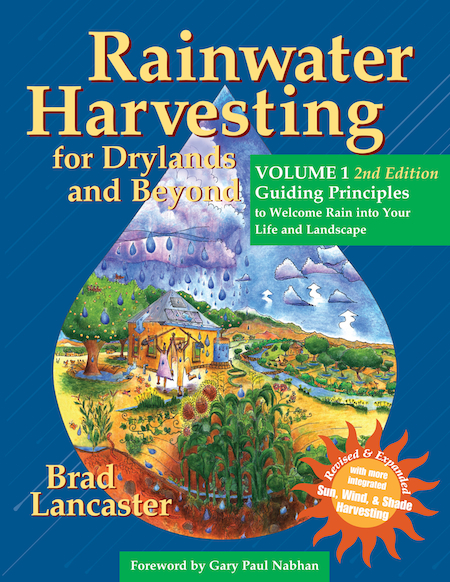
Rainwater Harvesting for Drylands and Beyond
Volume 1
Turn water scarcity into water abundance: guide on how to conceptualize, design, and implement sustainable water-harvesting systems for your home, landscape, and community.
On this page
by Brad Lancaster
Volume 1, 2nd Edition: Guiding Principles to Welcome Rain into Your Life and Landscape
Available from rainsource press
Reviews
“This wonderful book overflows with effective ways to beneficially cycle and enhance local water supplies, while maximizing power from the sun. It provides much-needed guidance and ideas on how to meet our resource needs, increase household and community potential, and protect the ecosystems upon which we all depend.”
-Sandra Postel, founding director, Global Water Policy Project; Freshwater Fellow of the National Geographic Society; author of Last Oasis
“In an age of enormous, industrial questions about resources, this book is an antidote. In these pages are solutions on a human scale, taking water not from massive reservoirs or river diversions but straight from the sky.”
-Craig Childs, author of The Secret Knowledge of Water
“Though a bizarre irony, rainwater in the arid west is typically deflected away from water-starved land and shunted off to storm drains at great expense. Not so in Brad Lancaster’s universe. He welcomes rainwater into the landscape with creativity, intelligence, and humor, and puts it to use growing and enhancing all kinds of resources, while reducing flooding and erosion, and enlivening the urban environment. In this new edition of Rainwater Harvesting for Drylands and Beyond, he welcomes us to join him in exercising the radical common sense of harvesting rainwater melded with the harvests of sun, wind, carbon, and more.”
-Ann Audrey, Environmental Consultant for integrating rainwater harvesting, habitat restoration, and edible trees
“This applies twice as much to the second edition: Buy this book now. If you live in a dry place, buy it. If you live somewhere subject to droughts (which is everywhere), buy it. The simple techniques (and the principles behind them) can help you save bundles of money, and make the landscape around you more productive and beautiful, with less work and upkeep than you can imagine. Lend it to your neighbors, and you’ll benefit as well. (Heck— buy them each a copy.) This how-to manual has enough stories, illustrations, and simple ideas to inspire even the most unhandy among us (such as myself). Buy it, try a couple of projects in your backyard, and in a few years be sure to send Brad and me a thank you note!”
-Kevin Dahl, former Executive Director of Native Seeds/SEARCH, and author of Wild Foods of the Sonoran Desert and Native Harvest: Gardening with Authentic Southwestern Crops
Introduction
Excerpts © 2013 Brad Lancaster
Turn water scarcity into water abundance! Rainwater Harvesting for Drylands and Beyond, Volume 1, 2nd Edition, is the best-selling, award-winning guide on how to conceptualize, design, and implement life-enhancing water-, sun-, wind-, and shade-harvesting systems for your home, landscape, and community. This book enables you to assess your on-site resources, gives you a diverse array of strategies to maximize their potential, and empowers you with guiding principles to create an integrated, multi-functional plan specific to your site and needs.
Clearly written with more than 280 illustrations, this volume helps transform your site from a consumer of resources to a producer of resources; reduce your cost of living; endow you with skills of self-reliance; and create community-building, living, air-conditioning vegetation that grows beauty, food, carbon-sequestration, flood-control, and wildlife habitat. Stories of people who are successfully welcoming rain, sun, wind, and shade into their life and landscape will invite you to do the same!
This new 2nd Edition...
- Adds over 120 new images, revisions of over 40 illustrations, for a total of over 280 images within this book
- Updates the real-life case studies to show their ongoing evolution (chapters 1 and 5)
- Adds more tools for integrating the harvest and enhancement of multiple free, on-site resources—such as wind, sun, and shade—in addition to water (chapter 4)
- Completely renovates the approach to seeing, understanding, and responding to flows of water and sediment (appendix 1)
- Dramatically expands a tool for tracking the seasonally changing path of the sun and its shadow, anytime and anywhere on earth (appendix 7).
In addition, this 2nd Edition provides the following new resources:
- One-Page Place Assessments, a tool to deepen your awareness of—and connection with—the place where you live, and to help amplify its regenerative potential (chapter 2)
- A harvest calendar of regional native, wild, and cultivated foods that can be used as a template for your area (appendix 4)
- An appendix to help you see, understand, and respond to the flow of wind and what comes with it, including soil, snow, heat, cold, fire, etc (appendix 8)
- An appendix describing the Water-Energy-Carbon Nexus, the myriad connections between these inputs and outputs, and how you can determine your lowest-energy-consuming, -water-consuming, and -carbon-emitting sources of water, energy, and more (appendix 9).
Forward
By Gary Paul Nabhan
Although rainwater harvesting has been accomplished by humans in virtually every drought-vulnerable region of the world for millennia, our society seems to have some collective amnesia about the utility, efficiency, sustainability, and beauty of these time-tried practices. Fortunately, this book and Brad's lifelong passion for practical, ecological, and aesthetically pleasing solutions to our water woes may cure us of that amnesia just when we most desperately need to remember such solutions are readily at hand. From where I write this is Northern Arizona, nine out of every ten trees outside my window are dead, due to the worst drought in fourteen hundred years, and the artificial reservoir known as Lake Powell is projected to go dry within six more years. And yet, those of my neighbors who harvest water off their roofs, parking lots, or slopes (as we do) have never had to haul in water during the last six years of subnormal precipitation, and elderly Hopi farmers have still produced crops every year in the floodwater (ak-chin) fields. At a time when surface- and ground- water is becoming increasingly privatized, fought over, and transferred between watersheds and aquifers as if were but one more globalized commodity, Brad demonstrates a diversity of strategies that can quench our thirst, sustain local food production, and keep peace among neighboring cultures. Because struggles for access to water are likely to be one of the most frequent causes for warfare and social unrest over the next half century on every continent, Brad should be nominated for the Nobel Prize for Peace for offering the world so many elegant means of avoiding such struggles through local harvesting of both water and traditional ecological knowledge.
Like many arid land ecologists scattered around the world, I was first inspired to consider the supreme importance of water harvesting for desert cultures by reading Michael Evenari's classic, The Negev -- The Challenge of a Desert, about Israeli Jewish attempts to learn from their ancient neighbors, the Nabateans, who drew upon diverse runoff catchments and storage practices to make their prehistoric civilization flourish at Petra, the Negev, and Sinai. With the likes of arroyo-of-consciousness journalist Chuck Bowden and straw-bale movement founder Matts Myhrman, I sought out older treatises and surviving practitioners of O'odham (Papago) ak-chin farming in the Sonoran Desert. We found that there was much to learn from our desert neighbors about the harvesting of both water and nutrients; Brad has continued and extended our earlier, haphazard efforts of rescuing such knowledge from Native American elders. But Brad has also gone two steps further than many of us. He has essentially accomplished a worldwide survey of water harvesting practices, humbling his predecessors by compiling a dizzyingly diverse portfolio of strategies, techniques, and technologies. He has then tried and fine-tuned every one of these strategies, so that he now has firsthand knowledge of how they function, and at what cost. His own desert abode is a like a walk-through encyclopedia of water harvesting techniques gleaned from cultures and innovators from around the world.
There is both quantitatively-informed precision and beauty in what Brad has implemented, and this combination is a rarity in our modern world. Technological fixes have grown increasingly ugly, but as you can see from the drawings and photos in this masterwork, Brad's designs sing to us as they solve our water shortages.
A half century ago, Thomas Merton prophesized that "some day, they will even try to sell you the rain," warning us that the privatization and corporate control of our hydrological destiny could become our doom. What Brad's genius safeguards for us is "water democracy," and I predict that this concept will become a keystone of environmental justice throughout the desert regions of the world, if not everywhere. We will no longer think of desert living as "lacking," or "limited," but celebrate the abundance before us. With tongue in cheek, we may even offer our sympathies to those who live in soggy, "drought-deficient" places, who may never be able to share the joy with us of harvesting our own fresh, delicious water, just as horned lizards have done off their very own backs since they first emerged on this dry planet. Blessings to you Brother Brad, the Patron Saint of Water Democracy.
Gary Paul Nabhan is desert rat author of The Desert Smells Like Rain and Coming Home to Eat, and Director of the Center for Sustainable Environments. Although he has a Ph.D. in arid land resources, he has learned more from Brother Brad than all his professors combined.
Preface to the 2nd Edition
People, farms, and even whole communities may periodically run out of fresh water, but planet Earth does not. Why? Because its living systems use water over and over through endless cycles in such a way that the quality of water--and the life it sustains--is not degraded. Instead it is maintained and even enhanced as it moves through myriad cycles. This increases what is possible, and leads to more life rather than less.
This book challenges you to do the same where you live. Push the limits. Strive to make your site’s beneficial cycles endless, along with their potential. Multiple strategies, tools, and examples are given to help you do this.
This second edition will greatly broaden your site’s array of possibilities by helping you integrate your awareness, harvesting, and cycling of water with other on-site resources such as sun, wind, shade, and community.
New and expanded aspects of this edition include:
- 100-plus pages of new information, over 120 new images, and revision of over 40 illustrations, to provide more than 280 total images enabling you to see in a new way Updated case studies of real-life examples including descriptions of their on-going evolution, to help inform your site design (chapters 1 and 5)
- The One-Page Place Assessment, a tool to deepen your awareness of--and connection with--the place you live to help you amplify its regenerative potential (chapter 2)
- Tools for identifying, integrating, and thus maximizing, the harvest and enhancement of multiple free on-site resources, including water (chapter 4 and appendices 5, 7, 8, and 9) A completely renovated approach to seeing, understanding, and responding to natural flows of water and sediment, so you can work with, not against, these flows (appendix 1)
- A harvest calendar of my region’s native, wild, and cultivated foods that you can use as a template for your area to help diversify and augment potential harvests there (appendix 4)
- Charts illustrating the water-energy-carbon nexus of sample households, and how a heightened awareness of this nexus informs actions that dramatically reduce your--and your community’s--consumption of water and energy, along with emissions of carbon and other contaminants. Better still, this informs actions that can dramatically increase the quality and quantity of non-polluting, locally renewable water and power sources (appendix 9)
Harvesting on-site water--primarily rainwater, but also stormwater, greywater (from household drains), and condensate--remains the core of this book. This edition also shows you how to combine water harvesting with harvests of other on-site resources in a way that generates and regenerates whole new resources.
This is all simple, fun, powerful, and often low cost or free. Best of all, we don’t have to do all the work when we and our systems are integrated with--or are in relationship with--our planet’s natural and perpetual conditions and processes. These include the force of gravity and materials moved by it; the sun’s differential heating of the Earth; air and ocean currents that are set in motion by this heating and the spin of the planet; the storms and rainwater these currents bring as the hydrologic cycle recirculates the Earth’s water; the solar-powered photosynthetic plants that grow tall while drinking, filtering, and releasing cooled water through leaves and fruits; the storm clouds regenerating from the cooled moisture--evapotranspired through the plants--which then condenses as raindrops around tiny air-borne particles of organic matter also generated by the vegetation; the sheltering shadows these plants cast; the leaf-drop-eating, fertility-building soil microbes that feed the plants, as the plants’ biomass and sugars feed the microbes; and the faunal life forms--including us--who are sustained by, and in turn have evolved to contribute to, this amazing self-renewing abundance.
Tapping this potential creates and enhances living legacies, which enrich those who are here now and will be cherished by those who inherit them. Everyone benefits in the present and across time.
This compelling vision is what generated this book, fed by years of my on-going hands-on learning, and the copious experience that others have shared with me. In turn, I share this vision, learning, and experience with you to raise the springboard from which we can launch to higher and more dynamic levels of awareness, understanding, caring, ability, action, abundance, and joy.
Contents
Contents
List of Illustrations
List of Boxed and Tabled Information
Acknowledgments
Foreword by Gary Paul Nabhan
Preface to the Second Edition
Introduction
My Rainwater-Harvesting Evolution
Who This Book Is For
How To Use This Book and Volumes 2 and 3
The Value of Rainwater
Rainwater Harvesting Through Land and Time
The Shift Away from Rainwater
Scarcity or Abundance
My Community’s Path
Our Path to Abundance
Questions and Answers about Rainwater Harvesting
Chapter 1. The Man Who Farms Water and the Rainwater-Harvesting Guidelines
The Man Who Farms Rainwater
The Eight Rainwater-Harvesting Principles
Water-Harvesting Ethics
2013 Update on Mr. Zephaniah Phiri
Chapter 2. Assessing Your Site’s Water Resources and More
The Hydrologic Cycle—Our Earth’s Circulatory System
Watersheds and Subwatersheds—Determining Your Piece of the Hydrologic Cycle
Calculate Your Site’s Rainfall Volume
Estimate Your Site’s Water Needs
Estimate Your Secondary On-Site Water Source—Greywater
Estimate Additional On-Site “Waste” Waters That Can Be Used As “Resource” Waters
A One-Page Place Assessment and How To Use It
Real Life Example: Living within a Dryland Home’s Rainwater Budget
Chapter 3. Overview: Harvesting Water with Earthworks, Tanks, or Both 61
How Do You Plan to Use Your Harvested Water?
Recommendations for Harvesting Water for a Landscape around a Home
Sampling of Strategies/Techniques
Overview of Water-Harvesting Earthworks
Overview of Cistern Systems
Real Life Example: The Running Rain Society
Chapter 4. Integrated Design
The Path of the Sun
The Seven Integrated Design Patterns
One: Orienting Buildings and Landscapes to the Sun
Two: Designing Roof Overhangs and Awnings to Optimize Winter Sun and Summer Shade
Three: Solar Arcs
Four: Sun & Shade Traps
Five: Maintaining Winter Sun Access
Six: Raised Paths, Sunken Basins
Seven: Reduce Paving and Make It Permeable
Integrating the Elements & Patterns of Your Site to Create Regenerative Investments
Tying It All Together: Creating An Integrated Design
Chapter 5. An Integrated Urban Home and Neighborhood Retrofit
Part One—Our Beginning: Realizing the Water-Harvesting Principles
Part Two—Our Evolution: Taking It Further With the Integrated Design Patterns
Part Three—Our Neighborhood: Collaborating for Leveraged Potential in the Wider Community
Appendix 1. Patterns of Water and Sediment Flow with Their Potential Water-Harvesting Response
Appendix 2. Water-Harvesting Traditions in the Desert Southwest by Joel Glanzberg
Appendix 3. Water-Harvesting Calculations
Appendix 4. Example Plant Lists and Water-Requirement Calculations for Tucson, Arizona, plus a Sonoran-Desert-Foods Harvest Calendar
Appendix 5. Worksheets: Your Thinking Sheets
Appendix 6. Resources
Appendix 7. Sun Angles and Path
Appendix 8. Wind Harvesting: Basic Airflow Relationships, Site Selection, Wind Pumping and Wind Power, Natural Ventilation, Windbreaks, and Snow- and Biomass-Drift Harvesting
Appendix 9. Water-Energy-Carbon Nexus
References
Glossary
Index
Other Publications
Index
Sample Figures & Photos
© 2013 Brad Lancaster and Joe Marshall
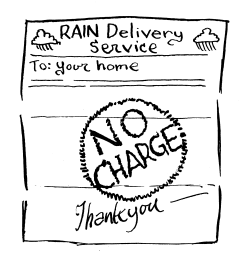
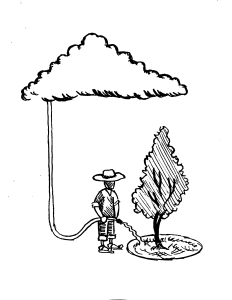
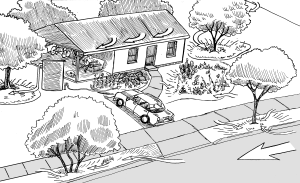
Rain is always free....Rain as our landscape's primary water source.
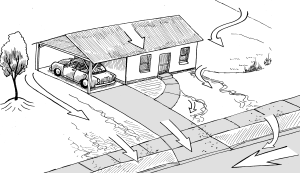
A landscape draining resources. Arrows denote runoff flow.
A landscape harvesting resources. Arrows denote runoff flow.
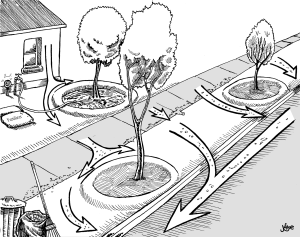
A landscape on the wasteful path to scarcity. Rain, runoff, and
topsoil are quickly drained off the landscape to the street where the
sediment-laden water contributes to downstream flooding and
contamination. The landscape is dependent upon municipal/well water
irrigation and fertilizer.
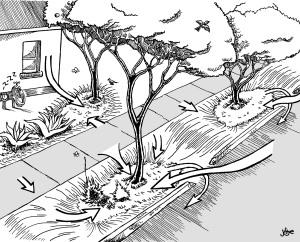
A landscape on the stewardship path to abundance. Rain, runoff, leaf
drop, and topsoil are harvested and utilized within the landscape
contributing to flood control and enhanced water quality. The system
is self-irrigating with rain and self-fertilized with harvested
organic matter.
Sample Chapters
- Appendix 3 Water-harvesting Calculations (128k PDF)
- Appendix 4 Example Plant Lists and Water-Requirement Calculations for Tucson, Arizona (128k PDF)
Keywords: rainwater, water, catchment, basin, landscape, harvesting, precipitation