
Gray Water Policy Center
A compilation of grey water regulations, suggested improvements to gray water policy, law & greywater policy considerations, sample permits, public health considerations, studies, etc.
For regulators, inspectors, elected officials, building departments, health departments, builders, and homeowners.
If you find this information useful, please consider leaving a donation in our Tip jar.
On this page:
Policy resources
Policy examples
Guidance for policymakers and government agencies
My advice to people writing regulations is simple: Copy Arizona. Don't copy California, the Uniform Plumbing Code, International Plumbing Code, or anyone else. The Arizona law could use a tune up, the other model codes need overhaul or scrapping. New Mexico has copied Arizona, and others are considering it.
- Greywater Laws and Improvements (pdf, 250k) Overview of suggested improvements, excerpted from our book the Builder's Greywater Guide.
- Testimony to the New Mexico state legislature Water and Environment Committee on desirability and characteristics of good grey water laws
- Material for a meeting of the New Mexico Department of Environment Grey Water Committee (word document focusing on quantitative, comparative health threats)
- Spreadsheet comparing health threats
from different waters (Excel spreadsheet including two graphs and a page
of calcs-see tabs on bottom)
Code writing and consultation service
Oasis Design can consult with your organization on all aspects of greywater policy, including public input, test installations, and the editing or writing of the codes and internal and public information materials. We have worked with the states of California, New York and New Mexico, and the cities of Santa Barbara, California; Cottonwood, Arizona; and Melbourne, Australia in this way. Please Email us if you are interested.
Model Greywater Ordinance
We've uploaded an editable model greywater ordinance, ready for adoption: Model greywater rules (pdf). Please Email us if you want to add something to this document (do it in track changes, then use our contact form to get our regular email address so you can send us the attachment).
Best Practices Informational Handouts, Code Compliance Packages, Workshops, Demonstration Sites, etc.
With regards to educating your public about greywater use, many agencies have found their most cost-effective measure is a link to ourGreywater central. You can see a partial list of agencies that we know to have done this at the bottom of ourLink to uspage.
We are committed to providing certain information free as a public service, long-term, at stable URLs that you can link to for free. Materials that have already been developed in cooperation with other jurisdictions can be shared at low cost. We can also pioneer new materials. Please Email us for references from jurisdictions for whom we've done work of this type.
Treatment effectiveness references
- Coliform bacteria measurements and standards: how to understand them and relate them to the real world
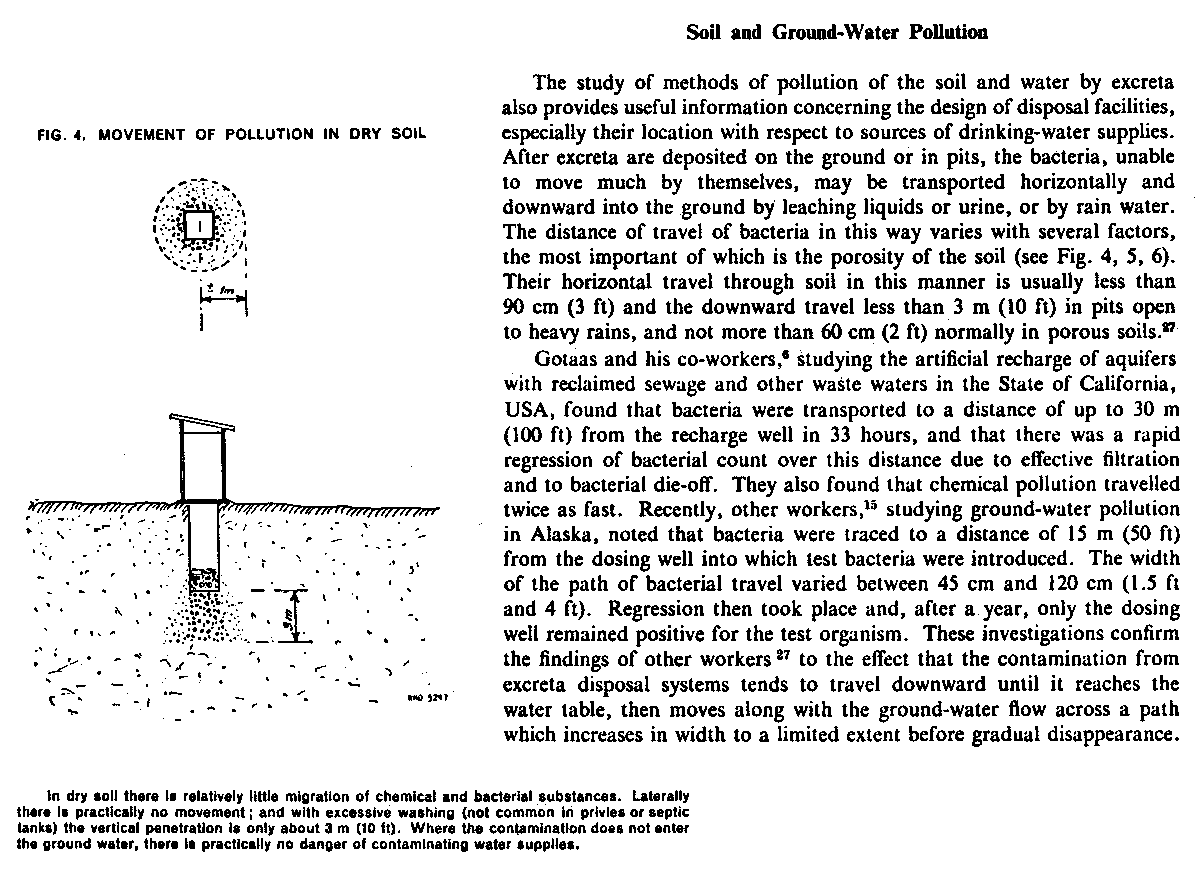
- The World Health Organization on pollution plumes from dry pit toilet (CIF graphic, large file)
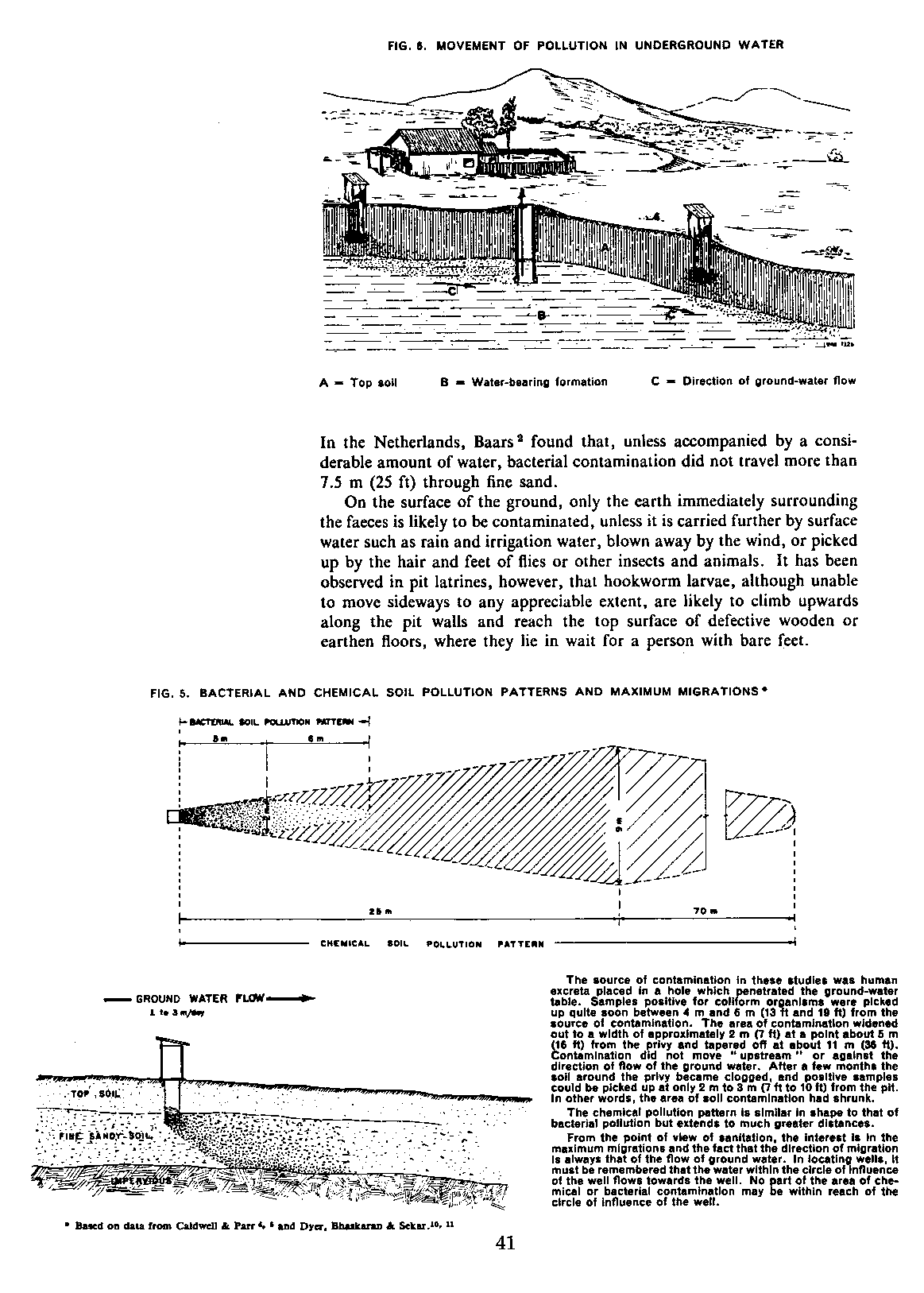
- The World Health Organization on pollution plumes from pit toilet in groundwater flow (CIF graphic, large file)
- Removal rates of land treatment facilities (PDF)
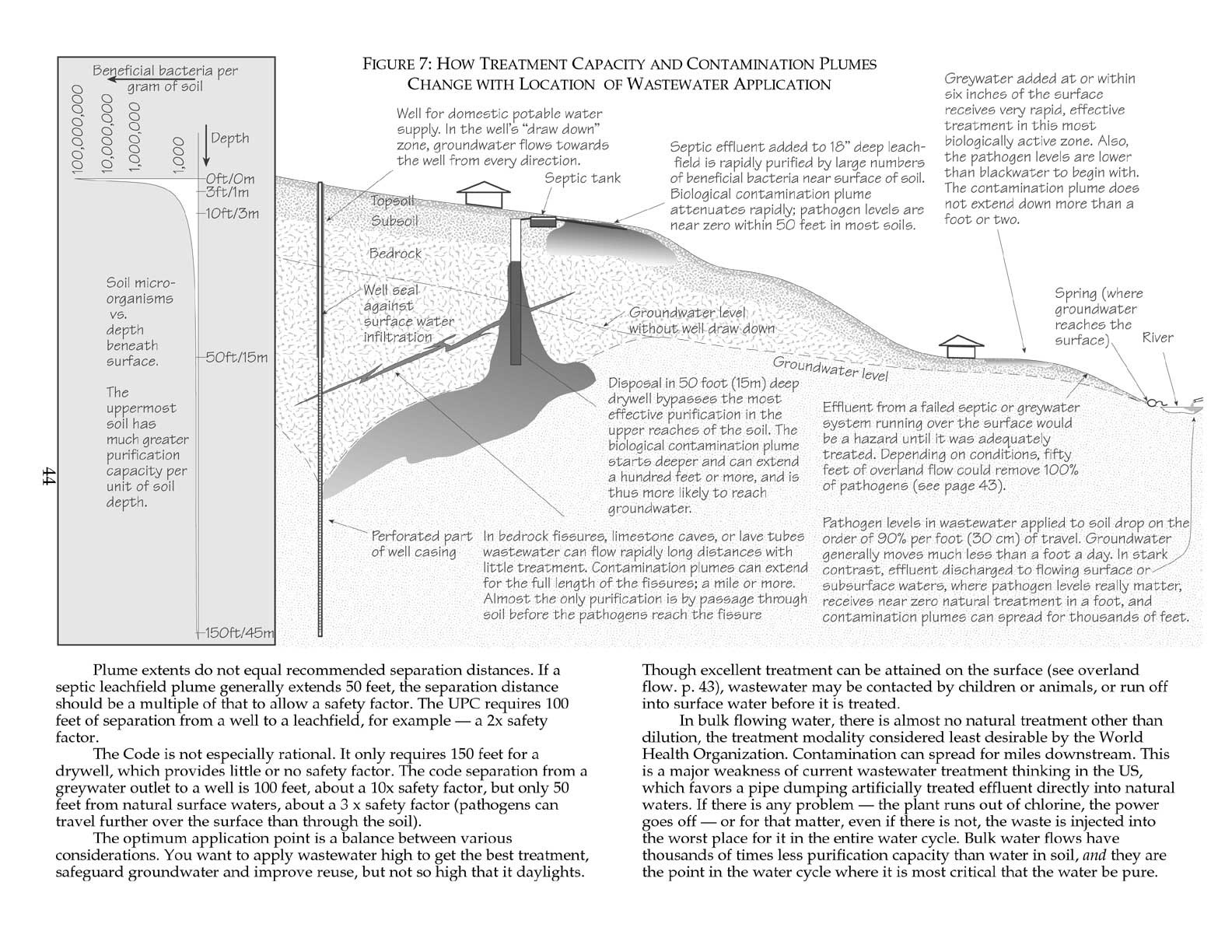
- Application depth vs. treatment effectiveness (jpeg graphic, 300k)
- Rincon oceanfront septic tank pollution study response
- Separation Necessary to Protect Groundwater Quality; Greywater vs. Septic Tank Effluent (PDF, 1mb)
- Guidelines for relating well with the natural water cycle, Six factors for natural Purification of Wastewater (PDF) page two
Soil Percolation and Loading Rates, Percolation Tests, and Long Term Acceptance Rate (LTAR)
—Or—Why soil perk is so much less critical for greywater systems than septic systems
(and why requiring professional percolation tests for greywater systems and outsized leaching area requirements are a waste of resources)
Table 16-2 and table G2/ (CPC and UPC greywater irrigation areas, respectively) are both simple port port-overs of UPC table K2, the uniform plumbing code standard for septic leachfield area. The loading rates are exactly the same. No thought or research has gone into distinguishing greywater and clarified septic tank acceptance rates in these laws, that I know of.
But, (shallow) greywater system LTAR is drastically different than (deep) septic leachfield LTAR:
- 90% of the beneficial bacteria, root hairs, and soil macro fauna are in the top foot of the soil. Perk in virtually all soils is much higher in this top zone than even two feet down, which is the typical minimum application depth for septic leachfields. This extra perk provides a generous extra margin of error.
- If mulch is used instead of gravel, basins do not seem to form a biomat the way leachfields do. In fact, the tilling action of worms and beetles at the soil/ mulch interface, and the increase in soil organic matter over time seem to substantially increase the LTAR (long term acceptance rate) of a properly designed and maintained mulch basin as compared to the perk of surrounding bare soil. This effect is well known to landscapers and gardeners (in our own yard we experienced a 30x increase in infiltration rate from 25 years of mulching, as measured with a double ring infiltrometer). In stark contrast, a biomat in a septic leachfield is expected to lower the LTAR to 1/100th of the initial perk rate, a factor built in to septic system design criteria that may be misapplied to mulch-basin disposal of greywater.
- Greywater has approximately 1/2,700th of the fecal matter that combined sewage has. Any reality-based risk assessment would clearly have to take this greatly reduced surfacing consequence into account, and balance it against the ecological and economic costs of larger leachfields (or, more to the point, lower marginal compliance rates as the greywater code loses credibility with users).
On the other hand,
- My experience suggests that the LTAR vs. loading rate curve climbs very steeply. When the aerobic capacity finally is exceeded at the soil interface, a mulch basin can go into a positive feedback loop in which much of the factor of 100 or so advantage of point 2) above is lost.
- the extreme variability of greywater characteristics relative to clarified septic tank effluent (consider the BOD of raw kitchen sink water, for example) argues for more conservative design (unless, of course, kitchen sink water is excluded).
- Mulch basins may be more sensitive to initial perk rate than leachfields.
Greywater mulch basins can sustain over 100 times the loading rate of adjoining leachfields under ideal conditions (in one instance I calculated that the greywater mulch basins legally required for a two shower bath house on an organic farm with exceptionally good soil tilth could safely process the combined sewage from half the neighborhood of surrounding tract houses for 24 hours, should the sewer system fail—something a lot more likely than greywater surfacing from that system).
However, ideal conditions do not always prevail. Overall, I believe that a reasonable, highly conservative standard for shallow (6-9") greywater-fed dispersal would be a loading rate twice that for deep septic leachfields.
In reality, I estimate that the LTAR for greywater applied shallow is on the order of twice that of a 24” deep septic leachfield on a given site with low percolation soil, and four times the LTAR on well-percolating soils. I'm sure these figures would double again for application under mulch as compared to soil (another reason to allow mulch to substitute for soil to shield people from contact with greywater).
Given this, and the much less drastic consequences of overloading a greywater system as compared to a septic system, it is hard to justify the economic and ecological costs of an "official" percolation test, requiring a backhoe, auguring equipment, truck, pipe, & gravel, when a homeowner can get all the information needed in an hour, with a shovel, hose, ruler, and a watch.
General references, studies
- A History of Greywater Regulation
- Greywater central
- Indoor greywater reuse
- Builder's GW Guide-book includes laws and treatment effectiveness info)
- Builder's action summary
- The National Small Flows Clearinghouse (Packet of regulations from state laws, assistance with on-site treatment)
- Arizona Water CASA greywater study
- Monitoring Graywater Use: Three Case Studies in California (pdf)
- Appendix 3 from the Humanure Handbook (1999) with the status of state regulations for composting toilets, graywater systems, and constructed wetlands
- Los Angeles Department of Water and Power grey water study
Arizona grey water code
This is the model to emulate, especially our slightly improved version: Greywater Laws and Improvements (pdf, 250k) Model greywater rules (pdf). Their three tiered system makes so much sense it is hard to justify regulating grey water any other way.
- My testimony to the New Mexico state legislature explaining why they should copy Arizona.
- AZ graywater rules copied from the official site to ours September 2002. This presents just the three grey water sections, clearly labeled as such, without having to sort through dozens of pages of unrelated regulations.
- R18-9-714. Type 1 - RECLAIMED WATER GENERAL PERMIT: GREY WATER
- Arizona brochure (pdf) Very succinct, two page overview of the key features of the law from the Arizona Department of Environmental Quality. This copy was placed on our server September 2002.
- Arizona Water CASA greywater study
- Arizona composting toilet and kitchen greywater code Title 18/18-09
- Cottonwood, Arizona Greywater Stubout Plumbing Ordinance (doc)
Arizona takes a three tiered approach to scrutinizing grey water systems:
1) Systems for less than 400 gallons per day that meet a list of reasonable requirements are all covered under a general permit without the builder having to apply for anything.
With this one stroke, Arizona has raised their compliance rate from near zero to perhaps 50%.
And, homeowners are more likely to work towards compliance for the informal systems that still fall short.
What's more, the door is now open for professionals to install simple systems.
2) Second tier systems process over 400 gallons a day, or don't meet the list of requirements, as well as commercial, multi-family, and institutional systems.
They require a standard permit.
3) Third tier systems are over 3000 gallons a day. Regulators consider each of them on an individual basis.
In Arizona, regulators apply oversight to grey water systems in rational proportion to their possible impacts.
Another wise feature of the AZ law: ... It does not proscribe design specifics.
Instead, regulators require that systems meet performance goals. They don't care how the system is built. They just want it to function well. This is the preferred approach. It creates a favorable climate for innovation, and the regulation is not as likely to be quickly outdated by technical progress.
The final idea I suggest you copy:
They have a short, simply worded law and a longer explanatory booklet.
The booklet can be more easily updated than the law.
For more see links above.
Here's the AZ regulation for tier one greywater systems:
|
R18-9-711. Type 1 Reclaimed Water General Permit for Gray Water A. A Type 1 Reclaimed Water General Permit allows private residential direct reuse of gray water for a flow of less than 400 gallons per day if all the following conditions are met: 1. Human contact with gray water and soil irrigated by gray water is avoided; 2. Gray water originating from the residence is used and contained within the property boundary for household gardening, composting, lawn watering, or landscape irrigation; 3. Surface application of gray water is not used for irrigation of food plants, except for citrus and nut trees; 4. The gray water does not contain hazardous chemicals derived from activities such as cleaning car parts, washing greasy or oily rags, or disposing of waste solutions from home photo labs or similar hobbyist or home occupational activities; 5. The application of gray water is managed to minimize standing water on the surface; 6. The gray water system is constructed so that if blockage, plugging, or backup of the system occurs, gray water can be directed into the sewage collection system or onsite wastewater treatment and disposal system, as applicable. The gray water system may include a means of filtration to reduce plugging and extend system lifetime; 7. Any gray water storage tank is covered to restrict access and to eliminate habitat for mosquitoes or other vectors; 8. The gray water system is sited outside of a floodway; 9. The gray water system is operated to maintain a minimum vertical separation distance of at least five feet from the point of gray water application to the top of the seasonally high groundwater table; 10. For residences using an onsite wastewater treatment facility for black water treatment and disposal, the use of a gray water system does not change the design, capacity, or reserve area requirements for the onsite wastewater treatment facility at the residence, and ensures that the facility can handle the combined black water and gray water flow if the gray water system fails or is not fully used; 11. Any pressure piping used in a gray water system that may be susceptible to cross connection with a potable water system clearly indicates that the piping does not carry potable water; 12. Gray water applied by surface irrigation does not contain water used to wash diapers or similarly soiled or infectious garments unless the gray water is disinfected before irrigation; and 13. Surface irrigation by gray water is only by flood or drip irrigation. B. Prohibitions. The following are prohibited: 1. Gray water use for purposes other than irrigation, and 2. Spray irrigation. C. Towns, cities, or counties may further limit the use of gray water described in this Section by rule or ordinance. |
Notes from/ about the Arizona experience
It has been pretty quiet in the field.
Some health service people hate the new law, but they can't demonstrate that anyone is getting sick, which is the only real concern.
Environmentalists upset that grey water + composting toilets are not allowed has been the main feedback coming back to the Department of Environmental Quality (see the department's clarification, PDF, 12k).
AZ DEQ is planning to revise the rules in 2003. They are considering allowing kitchen sink water if a grease trap is used, and kitchen sink water is applied subsurface. This would solve the composting toilet issue, as kitchen sink water wouldn't be left out in its own, awkward third system.
Phoenix is not interested in grey water. Rural areas and Southern Arizona are very interested (13% were already reusing grey water in Southern Arizona prior to the law change, according to the Arizona Water CASA greywater study).
Builders of new homes in Southern Arizona are open to the extent that they are considering embracing a law which requires dual plumbing in new construction.
The big missing link is qualified retrofit installers.
Note on the Arizona greywater study kitchen sink fecal coliform levels
Much has been made of the fecal coliform levels in kitchen sink water in the
Arizona Water CASA greywater study. The 88,400 fecal coliforms/ 100 ml level was used to justify excluding kitchen sink water from the greywater regulation. This equates to nearly a gram per day of mammalian fecal matter going down the kitchen sink, which defies common sense (more on this in understanding fecal coliform counts).
This high reading is most likely caused by indicator organisms growing in the plumbing due to the nutrients in the food bits in the sink. Does this mean pathogens also breed? If so, extra caution is warranted, if not, then not.
This question can and should be resolved by comparing indicator to pathogen levels at different points in the plumbing; the sink, the trap, the outlet.
Even if pathogens do breed in the kitchen sink plumbing, the levels are still 98% less than the 5,000,000 typical fecal coliform level in raw sewage, so the kitchen sink water could reasonably be handled by a more stringently designed greywater system.
Contacts
Kwami Agyare, Engineering approvals unit 602 -771-4664
Chuck Graf 602-771-4661 author of grey water guidelines.
The Water Conservation Alliance of Southern Arizona provided the impetus behind the rationalization of grey water laws in Arizona.
More Arizona grey water links:
- Update Program for Onsite Systems Rule:
- Arizona composting toilet and kitchen greywater code: This covers the composting toilet/ kitchen sink and greywater issues.
- Pre-esale Inspection Program Information and Forms: http://azdeq.gov/environ/water/permits/wastewater.html#new
- Compliance and Enforcement Handbook: http://azdeq.gov/lead/osc/handbook.html
- ADEQ Web site: http://azdeq.gov
Uniform Plumbing Code (UPC) grey water model code
It's like the California grey water law, which it is patterned after, except worse.
- UPC&CPC improvements Somewhat dated, but (unfortunately) still mostly accurate as to where the problems are.
- Builder's GW Guide-book contains the complete text of the California law, extensively annotated, including most all differences with UPC and what they mean.
International Plumbing Code (IPC) grey water model code
See: How to improve IPC grey water law
California grey water code
California revamped its greywater code (part of its plumbing code, the CPC) in August 2009.
- CA gray water policy center The California section got so big we gave it it's own page; you'll find most of the info here.
- California Graywater Code
- History of greywater regs
- CA Senate Bill 1258 (passed July 2, 2008) directs the Department of Housing and Community Development to develop a more wide-ranging set of standards for graywater systems for both indoor and outdoor uses. These new standards will then be recommended to the California Building Standards Commission for adoption.
- California Graywater Guide (pdf)
- Builder's GW Guide-book contains the complete text of the current California law, extensively annotated.
- Stub outs: How to inspect or construct legal stub outs for a future grey water system in California
- CA Department of Health Services Guide to the Safe Use of Grey Water
- Why is the 2007 CPC greywater section (chapter 16) suddenly retrograde? Apparently the CA Building Standards Commission screwed up and put in the ancient Appendix J—a retired relic from the dark ages, without the 1997 improvements, into the 2007 CPC. They subsequently have included the correct version as an errata "Appendix G" as a canary colored insert in back of code!
Malibu, CA grey water ordinance
Malibu developed their own innovative greywater law. Their graywater handbook produced by Peter Warshall and Associates in 1995 is a very interesting resource and reference point for jurisdictions crafting standards for their own particular situations.
The mulch basins are a good feature, and their policy of not requiring a permit application for a single fixture greywater system is refreshingly realistic.
Connecticut
Committee Bill 6414- 2001- AN ACT CONCERNING A MUNICIPAL PILOT PROGRAM FOR GRAY WATER- establishes a pilot program for the use of gray water from publicly owned treatment works. As part of the pilot program, the department may approve the use of such treated gray water in public schools and municipal facilities in manners determined by the department, provided such uses do not negatively impact public health.
Colorado grey water law
This is a message from a visitor to the Oasis web site:
Colorado needs some help too! Can only use the grey water for below ground use, in other words make a leach field as the only accepted use.
More rumors, from various sources, indicate fairly liberal attitudes by Colorado inspectors in practice. Anyone able to shed light on this apparent contradiction?
(Another visitor message) Colorado Health Department (State) is UNsympathetic. We need a new state law. Individual counties are usually sympathetic to grey water, but don't want to violate state law.
Best method is to plumb the house as if recycling grey water, install a "Y" valve going to the septic tank, and after Certificate of Occupancy is issued, divert the flow to wherever you want. Inspectors don't care.
Obvious drawback is one has to build a septic system.
Montana
HB 259 allows single-family residences to reuse gray water, and legalizes all systems installed before the legislation went into effect on October 1, 2007.
Montana HB259 follows civilized world in definition of greywater, also used in the European Union and Australia, which includes kitchen sink water:
Section 1. Definitions. As used in this part, unless the context indicates otherwise, the following definitions apply:
(1) "Gray water" means wastewater that is collected separately from a sewage flow and that does not contain industrial chemicals, hazardous wastes, or wastewater from toilets.
(2) "Gray water reuse system" means a plumbing system for a private, single-family residence that collects gray water.
Nevada
NAC 444.837 System utilizing graywater for underground irrigation: General requirements. (NRS 439.200, 444.650)
1. Graywater may be used for underground irrigation if approved by the administrative authority. A homeowner must obtain a permit to construct, alter or install a system that uses graywater for underground irrigation from the administrative authority before such a system may be constructed, altered or installed.
2. A system that uses graywater for underground irrigation:
(a) May be used only for a single-family dwelling.
(b) Must not be used in soils which have a percolation rate that is greater than 120 minutes per inch.
(c) Must consist of a three-way diversion valve, a holding tank for the graywater and an irrigation system.
(d) May be equipped with a pump or siphon, or may rely on gravity to cause the water to flow to the irrigation system.
(e) Must not be connected to a system for potable water.
(f) Must not result in the surfacing of any graywater.
3. A system that uses graywater for underground irrigation, or any part thereof, must not be located on a lot other than the lot which is the site of the single-family dwelling that discharges the graywater to be used in the system.
(Added to NAC by Bd. of Health by R129-98, eff. 3-25-99)
NAC 444.8372 System utilizing graywater for underground irrigation: Application to construct, alter or install system; design criteria. (NRS 439.200, 444.650)
1. An application to construct, alter or install a system that uses graywater for underground irrigation must include:
(a) Detailed plans of the system to be constructed, altered or installed;
(b) Detailed plans of the existing and proposed sewage disposal system; and
(c) Data from percolation tests conducted in accordance with NAC 444.796 to 444.7968, inclusive.
2. A holding tank for graywater must:
(a) Be watertight and constructed of solid, durable materials that are not subject to excessive corrosion or decay.
(b) Have a minimum capacity of 50 gallons.
(c) Have an overflow and an emergency drain. The overflow and emergency drain must not be equipped with a shutoff valve.
3. A three-way diversion valve, emergency drain and overflow must be permanently connected to the building drain or building sewer and must be located upstream from any septic tanks. The required size of an individual sewage disposal system must not be reduced solely because a system that uses graywater for underground irrigation is being used in conjunction with the individual sewage disposal system.
4. The piping for a system that uses graywater for underground irrigation which discharges into the holding tank or is directly connected to the building sewer must be downstream of any vented trap to protect the building from possible sewer gases.
5. The estimated discharge of a system that uses graywater for underground irrigation must be calculated based on the number of bedrooms in the building, as follows:
(a) For the first bedroom, the estimated discharge of graywater is 80 gallons per day; and
(b) For each additional bedroom, the estimated discharge of graywater is 40 gallons per day.
6. The absorption area for an irrigation system that includes a system that uses graywater for underground irrigation must be calculated in accordance with the following table:
Percolation Rate (minutes per inch) |
Minimum Square Feet Per 100 Gallons Discharged Per Day |
0-20 |
20
|
21-40 |
40
|
41-60 |
60
|
7. The following is a diagram of a system that uses graywater for underground irrigation:
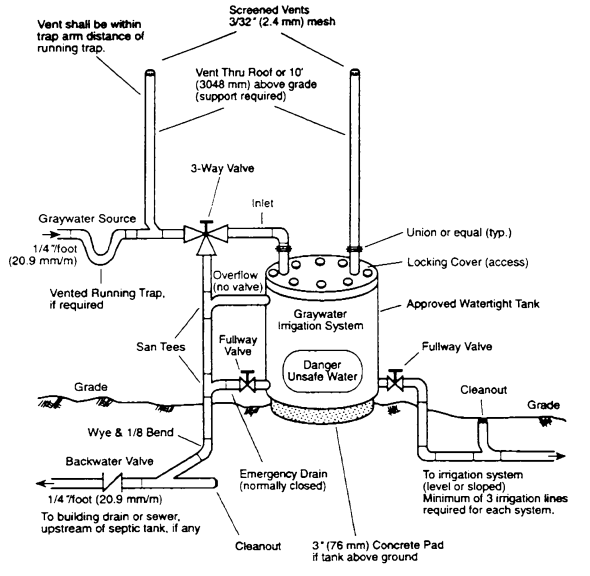
(Added to NAC by Bd. of Health by R129-98, eff. 3-25-99)
(This hated, misleading image was removed from the CA greywater code in 2009; pretty much no greywater system has ever been built this way.)
New Jersey
(This is a spurious entry included because it is an interesting case of lawmakers confusing the definitions of reclaimed water and grey water.)
Senate Committee Approves Business = Tax Benefits for Water Conservation-
Businesses that undertake certain large-scale water conservation projects would
get substantial tax benefits under NJBIA-backed legislation released by the
Senate Budget and Appropriations
Committee on February 26. The bills, A-2380/A-2381 (Bagger, Suliga) , are aimed
at helping companies capture, treat and use "gray water" in their
production processes. "Gray water" is treated effluent that is normally
discharged into waterways by local sewage-treatment facilities. By capturing
it, treating it further, and using it for non-drinking water in their factories,
businesses can conserve millions of gallons of potable water suitable for drinking.
A-2380 would provide a 20 percent investment tax credit against the corporation
franchise tax for purchase of equipment used to treat effluent from a wastewater
treatment system. A-2381 would exempt the purchase of this equipment from the
sales and use tax.
New Mexico
Old New Mexico grey water law considered greywater as part of septic system law—a bad idea.
New greywater law based on Arizona model—a much better approach—signed March 11th 2003
HB114 -- Facilitating Gray Water Use in NM Landscapes
See summary below or go to the full legislation on the official site.
Rep. Mimi Stewart was the bill's lead sponsor.
3/8/03--We did it! HB114 that allows us to use gray water for residential
landscapes passed the Senate yesterday with only two senators voting against 35 others who voted in favor!
Thanks to everyone who called, emailed and testified over the last weeks. Your
efforts made a real difference!
Also, since the bill has an emergency clause tacked on to it, the bill will
go into effect immediately
--instead at the beginning of the fiscal year in July.
This will be great for New Mexico!
Thanks, Melissa McDonald
What would HB114 do?
HB114 simplifies state code so that gray water can be used safely in the landscape.
Currently state code does not differentiate between black and gray water (defined below). This makes gray
water re-use prohibitively expensive. By making the necessary distinction and creating safe guidelines,
we will take an essential step in conserving New Mexico’s most valuable resource for future generations.
With essentially no expense to the state, the positive effect of HB114 would be immediate.
HB114 would NOT undermine any local ordinances, because it allows for towns,
cities, and counties to be more restrictive when it comes to gray water reuse
What is Gray Water?
Technically, gray water is untreated household wastewater that has not come
in contact with toilet waste (black water). Primarily, gray water includes waste water from bathtubs, showers,
bathroom sinks, and clothes washing machines. HB114 also stipulates that wastewater from kitchen sinks,
dishwashers and the washing of material soiled with human excrement to be "black water".
Is Gray Water Safe?
Yes. When handled properly, gray water is safe. HB114 includes best management
practices developed to protect public health and water quality. Arizona and Texas already have gray water regulations
similar to HB114. Many of the rules in Arizona are based on an extensive study conducted in Tucson,
which can be found at http://ag.arizona.edu/AZWATER.
- Every gray water distribution system must provide for overflow into the sewer;
- Gray water storage tanks must be covered;
- Systems must not be sited in floodways;
- Gray water must be stored at least five feet above the ground water table;
- Pipes must be clearly identified;
- Gray water must not run out of a homeowner’s property;
- Contact with people or domestic pets must be minimized;
- Ponding of gray water is prohibited;
- Spraying of gray water is prohibited;
- Gray water must not be discharged to a watercourse;
- Use of gray water must comply with local ordinances ; and
- No more than 250 gallons of gray water can be used in a given day.
Some of the benefits of this new Gray Water Reuse Legislation:
Conserves Water
Beautifies Communities
Saves money on water bills
Supports water efficient homes
Saves water for future generations
Reduces demand on water systems
Creates plumbing and landscaping jobs
If you would like more information on this bill, please contact:
Melissa McDonald 424-4444
Paul Paryski 660-4077
Representative Mimi Stewart 986-4341
New York
A11028-2002- To encourage water conservation by requiring the Department of Environmental Conservation to promulgate regulations regarding the use of reclaimed wastewater and gray water. - passed Assembly, sent to Senate 4/02.
Green building tax credit includes "alternate supply water:" gray water, rainwater, runoff, and groundwater which enters basement pumps.
- Full text of law from state web site (PDF, 269k, 156 pages). Greywater info is in definitions and on pages 95-98.
- Tax credit info from state web site.
Massachusetts
Oregon
HB3320- 1995- Requires Department of Environmental Quality to establish guidelines for use of grey water and to seek approval of United States Environmental Protection Agency for guidelines.
A visitor from Corvallis, OR shared the following perspective:
Current law allows such minimal and restricted greywater use that changes should be made legislatively. Past attempts have failed, but have been only loosely organized.
Oregon Recode's Greywater Page.
Texas
[Updated 1/29/09]
Texas has followed the lead of Arizona and New Mexico.
Texas Gray Water Standards copied from the sites below, to ours, January 2009.
Rule 285.81-Texas Administrative Code, 2001- Summary: permits are not required for domestic greywater systems that use less than 400 gallons per day, and follow the requirements listed in the rule (follow link for more info).
General Texas water code, search for part of code that deals with graywater (was section 26.0311 as of this writing)
Texas Health and Safety Code "Graywater Standards" (scroll to section Sec. 341.039. GRAYWATER STANDARDS.)
Study (pdf) done by Texas A&M university that puts the Texas Administrative Code concerning on-site grey water systems into a clear and easy to read format with good diagrams. It states that greywater from washing machines, bathtubs, and non-kitchen sinks can be used in greywater systems.
Utah
Utah Blows it on New Greywater Reg
Despite having excellent examples to follow in its neighbors Arizona and New
Mexico, Utah has instead enacted a law which
is worse than useless. It actually outdoes California's former greywater policy in making virtually no
practical greywater installation legal, with this section:
(ii) Surge tanks shall be:
(A) at least 250 gallons in volumetric capacity to provide settling of solids,
accumulation of sludge and scum unless justified with a mass balance of inflow
and outflow and type of distribution for irrigation...
Anyone who makes the mistake of believing the law's implication that a tank of this large size is in any way advantageous will end up convert innocuous greywater to festering, anaerobic blackwater.
This provision illustrates two basic greywater errors:
The prohibition of sub-mulch irrigation is the nail in the coffin for all greywater technologies other than branched drain to infiltrators or subsurface drip irrigation, both a stretch for single family homes.
The provision that local jurisdictions have to request certification and demonstrate that they have the resources to process greywater permits is a novel one. Not a bad idea if there was any reason whatsoever to build a greywater system with a permit, but just a bad joke considering that there isn't.
Predicted result: Less than ten permits will be pulled for greywater systems under this law in the next five years. Illegal installations will continue unabated, and professionals will not be able to get involved in installing sensible systems due to their illegality.
Vermont
H301: This bill proposes to require the use of gray water for toilet water in state buildings. DID NOT PASS
Washington State
Washington State grey water code
Washington State grey water information
Wyoming
[Updated 4/27/10]
Wyoming law allows residential greywater systems, including wastewater from baths, showers, bathroom wash basins, clothes washing machines, sinks (including kitchen sinks) and laundry tubs. Oasis Design publications are listed as resources on the Department of Environmental Quality reference brochure.
Wyoming State greywater policy (PDF, 71k)
Wyoming Greywater Guide (PDF, 715k)
Greywater defined:
- Household wastewater which has not been contaminated by toilet discharge (blackwater). Greywater includes wastewater from baths, showers, bathroom wash basins, clothes washing machines, sinks (including kitchen sinks) and laundry tubs.
Greywater re-use systems that match the following conditions will be permitted on a "permit by rule" system as described in chapter 16 of the State of Wyoming Water and Wastewater Rules. That is to say that no application for a permit or fee is required if all the following conditions are met:
- Human contact with the greywater will be minimal.
- Water which has been used to wash diapers or similarly soiled or infectious garments is not allowed into the greywater system unless the greywater system is designed to prevent human or animal contact.
- Greywater does not come in direct contact with or adversely impact surface or groundwater.
- The potable water system must be isolated from the greywater system by the appropriate backflow methods and devices.
- Greywater does not leave the property on which it is generated without written, legally recorded, permission from all land owners affected.
- Water which contains hazardous materials cannot be disposed of in a greywater system.
- Greywater sprayed into the air for irrigation or other purposes during high wind conditions cannot come into contact with humans, domestic animals or the edible portion of food crops during normal operation.
- The application of greywater minimizes the pooling of water on the ground surface.
- Greywater holding tanks, if used, shall be covered or otherwise protected from access by mosquitoes, children, animals, or other life forms.
- The volume of greywater produced does not exceed an average of 2000 gallons per day.
- In addition, at least one of the following conditions must also be met:
(a) The greywater system has been constructed to allow diversion of the flow to the black water disposal system, and the blackwater system (septic tank, sewer, etcetera) is sized adequately for both greywater and blackwater or: |
Greywater systems that do not meet the above criteria shall submit a permit application to the State of Wyoming Department of Environmental Quality to be evaluated on an individual basis.
Australia
There is information on greywater in Australia in the Builder's GW Guide-book.
Jordan
Jordan is working with people from Arizona on a new greywater policy, which can be seen along with a report and other material on greywater use on the CSBE website.
Links
A list of greywater state regs in the US from the greywater guide
Tip Jar
We've added a
Tip jar  feature to the Oasis site to make it easy for those who appreciate our several hundred pages of free information to contribute to the maintenance and expansion of this body of free content.
The more people use the tip jar, the more of the thousands of pages of our unpublished original designs we'll be able to open source like this.
If you've saved tens of thousands of dollars on your construction projects, thousands of dollars on bicycle transportation over cars, had your life saved by our dengue fever information, or gotten some other significant benefit from our site and you don't need and books or downloads, please consider donating:
If there is a particular page or topic you want to support, please mention it in the comments field.
You choose the number of tips, in dollar increments...any credit card, pay pal, e check...
Thanks!
—The Oasis team